
Best Turso Alternatives in 2026
DuckDB (free) handles local analytical queries faster than Turso can. Switch if you need serverless OLAP performance rather than thousands of edge-replicated databases.
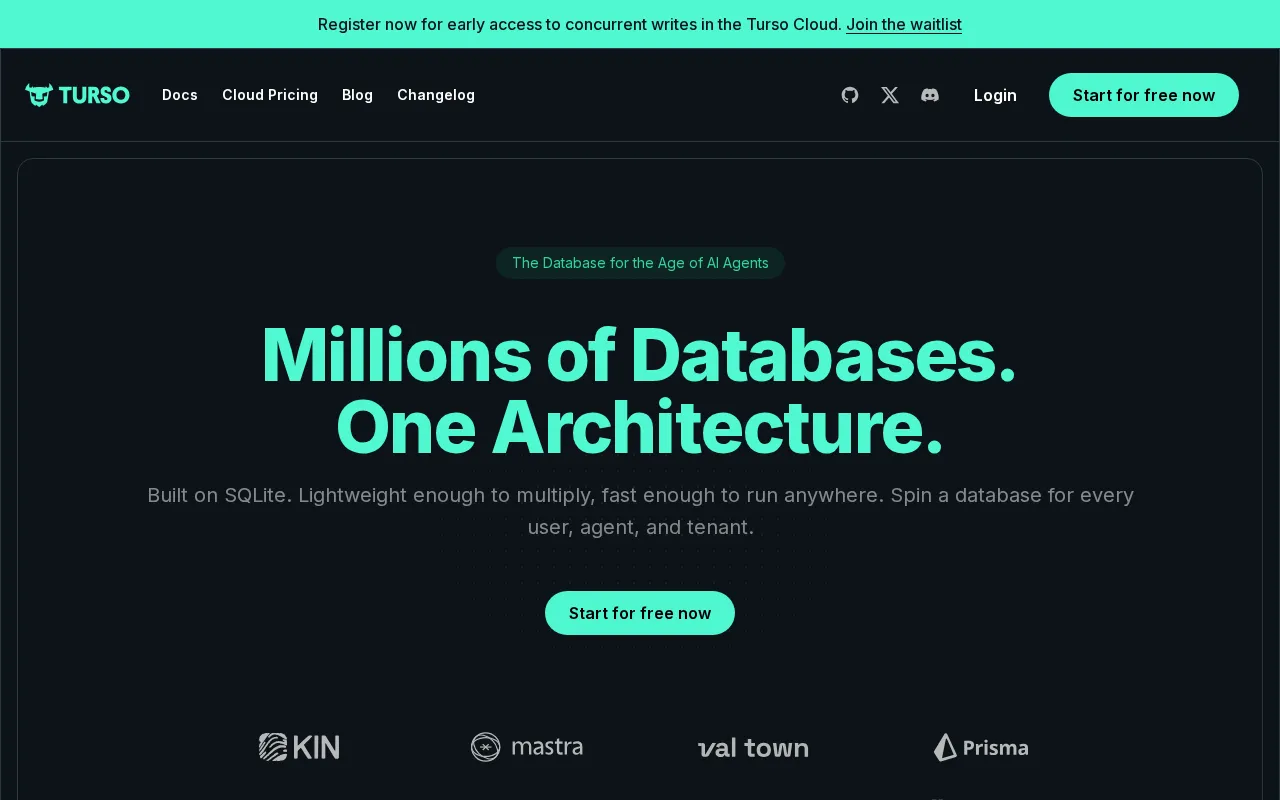
Feature Overview: Top Turso Alternatives
Turso compared against all 13 databases alternatives. Pricing, free plan availability, rating, and databases-specific capabilities.
| Tool | Price | Free Plan | Rating |
|---|---|---|---|
 | $4.99/mo | - | |
 | $1800/mo | 4.6G2 | |
 | Free | 4.4G2 | |
 | $5/mo | 4.5G2 | |
 | Pay-as-you-go | No | 4.6G2 |
 | Custom | No | 4.6G2 |
 | $99/mo | 4.5G2 | |
 | $66.52/mo | 4.5G2 | |
 | Pay-as-you-go | 4.3G2 | |
 | Pay-as-you-go | 4.3G2 | |
 | Pay-as-you-go | 4.4G2 | |
 | Free | 4.2G2 | |
 | Pay-as-you-go | - | |
 | Free | - |
How Does Turso Compare to Alternatives?
Independently verified metrics. Sources: Vendor benchmark pages, TPC-H results. Verified 2026.
| Tool | QPS | P99 Latencyms | Max Concurrent | Compressionx |
|---|---|---|---|---|
| PostgreSQL | 100,000 | 5 | 500 | 2 |
| Redis | 1,000,000 | 0.5 | 10,000 | 1 |
| Snowflake | 5,000 | 500 | 200 | 5 |
| Databricks | 10,000 | 200 | 500 | 3 |
| ClickHouse | 500,000 | 10 | 1,000 | 5 |
When Should You Stick with Turso?
Alternatives are not always the right move. Turso remains strong in these scenarios.
- +SQLite familiarity with global edge replication
- +Database-per-tenant trivially cheap for multi-tenant SaaS
- +Sub-10ms reads globally via edge deployment
- +Strong TypeScript/edge ecosystem integration
- -Not suitable for write-heavy high-throughput workloads
- -SQLite limitations (no stored procedures, limited SQL)
Turso Alternatives by Data Use Case
13 database solutions compared. Choose based on query patterns, scale, and consistency requirements.
Expert Take
The overage model is where the bill goes sideways. Turso meters four things at once: storage, rows read, rows written and syncs, each with its own rate. Overages must be switched on. Leave them off and you hit a wall instead of a charge.
 Oleh KemFounder & Lead Analyst
Open-source distributed SQL database with MySQL compatibility for HTAP workloads.. Rated 4.7/5 vs 4.5/5 for Turso.
- +HTAP eliminates separate analytics warehouse for many use cases
- +MySQL compatibility reduces migration complexity
- +Strong horizontal scaling for high-write workloads
- +Free serverless tier for development
- +HTAP (Hybrid Transactional/Analytical)
- +MySQL Wire Protocol
- +Horizontal Scaling
- +TiFlash (Columnar Engine)
- −It is very unusual and jarring that the IDs in different tables jump and do not start from zero.
- −TiDB Cloud can be improved, particularly because the interface is very old.
An advanced open-source relational database with powerful extensions for geospatial, time-series, and AI applications.. Has a free tier that Turso lacks.
- +Extensible architecture supports GIS, time-series, and vector data
- +ACID compliance and MVCC ensure high data integrity and concurrency
- +Advanced indexing (GIN, GiST, BRIN) accelerates complex queries
- +Rich data types including native JSONB, arrays, and range types
- +Mature, battle-tested reliability for mission-critical applications
- +ACID Transactions
- +Advanced SQL
- −Requires manual tuning for high-throughput, write-heavy workloads
- −Connection management can be resource-intensive at massive scale
- −No built-in horizontal scaling; requires third-party solutions
In-memory data structure store for caching, pub/sub, and latency-sensitive workloads.. Priced higher at $5/mo vs $4.99/mo.
- +Sub-millisecond latency: fastest data store for caching
- +Universal: supported by every framework and language
- +Rich data structures for real-time use cases
- +Redis Stack adds search, JSON, and vector capabilities
- −There are some points where I feel Redis can be improved.
- −There are a few areas where Redis could improve.
- −Redis could improve its efficiency in handling locally stored data, not just Amazon Cloud or Google Cloud.
A cloud data platform that unifies warehousing, data lakes, and AI/ML workloads with decoupled storage and compute.. Rated 4.7/5 vs 4.5/5 for Turso.
- +Decoupled storage/compute allows independent, instant scaling
- +Zero-copy cloning creates instant, writable copies for dev/test
- +Secure Data Sharing enables live data access without ETL
- +Snowpark offers native Python/Java/Scala processing in-database
- +Consistent experience and replication across AWS, Azure, and GCP
- +Separation of Storage and Compute
- +Multi-Cluster Warehouses
- −Credit-based pricing can be complex and lead to unpredictable costs
- −Lacks fine-grained indexing control, impacting some query tuning
- −No support for on-premise or hybrid deployments; cloud-only
Unified data and AI platform combining Delta Lake, SQL analytics, and ML training on a single platform.. Rated 4.7/5 vs 4.5/5 for Turso.
- +Lakehouse architecture eliminates ETL between data lake and warehouse
- +MLflow is the de-facto ML experiment tracking standard
- +Unity Catalog provides unified governance across data and AI
- +Delta Lake open format avoids vendor lock-in
- +Delta Lake (Open Table Format)
- +Apache Spark
- +MLflow (ML Tracking)
- −As a data engineer, I see cluster failure in our Databricks user databases as a major issue.
- −I heard that a new feature is being developed for SAP that can bring SAP data directly into the platform for generating reports.
- −The API deployment and model deployment are not easy on the Databricks side.
Distributed search and analytics engine built on Apache Lucene for full-text search and log analytics at scale.. Priced higher at $99/mo vs $4.99/mo.
- +Best-in-class full-text search with relevance tuning
- +Rich aggregation engine for log analytics and dashboards
- +Massive ecosystem with Logstash, Kibana, and Beats
- +Full-text search
- +Inverted index
- +Distributed sharding
- −I have not explored Elastic Search at the most.
An open-source, column-oriented OLAP database for real-time analytics on petabyte-scale event and time-series data.. Priced higher at $66.52/mo vs $4.99/mo.
- +Scans billions of rows per second via vectorized query execution
- +Materialized Views for real-time, incremental data aggregation
- +High-ratio data compression (LZ4, ZSTD) drastically cuts storage costs
- +Natively handles semi-structured data (JSON, maps, arrays) at scale
- +Full-featured, production-ready open-source core; no vendor lock-in
- +Column-oriented storage
- +Vectorized query execution
- −No multi-row transactions (ACID); not suitable for OLTP workloads
- −Point updates and deletes are expensive, batch-oriented operations
- −Limited full-text search capabilities compared to dedicated search engines
The most widely deployed open-source relational database, powering WordPress, Drupal, and most PHP apps..
- +Most widely deployed database: abundant expertise and tooling
- +Battle-tested for 30 years on the web
- +HeatWave adds analytics and ML without ETL
- +Available managed on AWS RDS, Azure, GCP
- +ACID Transactions (InnoDB)
- −The data masking functionality should be improved as well as the native encryption functionality in the MySQL database.
- −The performance issues in the product can be considered as an area where improvements are required.
- −In MySQL, we need to define every table beforehand.
Showing 8 of 13 alternatives
Common Questions About Switching from Turso
Sources & verification
| Source | What was checked | Last checked |
|---|---|---|
| Official Website | Official vendor website | — |
| Official Pricing Page | Source of verified tiers | July 16, 2026 |
Every fact on this Turso pricing page is tied to a named source and a verification date. Freshness-sensitive figures trace to the sources above; verify against the vendor before relying on them.