
DuckDB Pricing: Plans & Cost Guide 2026
Paid database alternatives target enterprise teams, but DuckDB offers 1 open-source plan that is free for life with zero recurring fees.
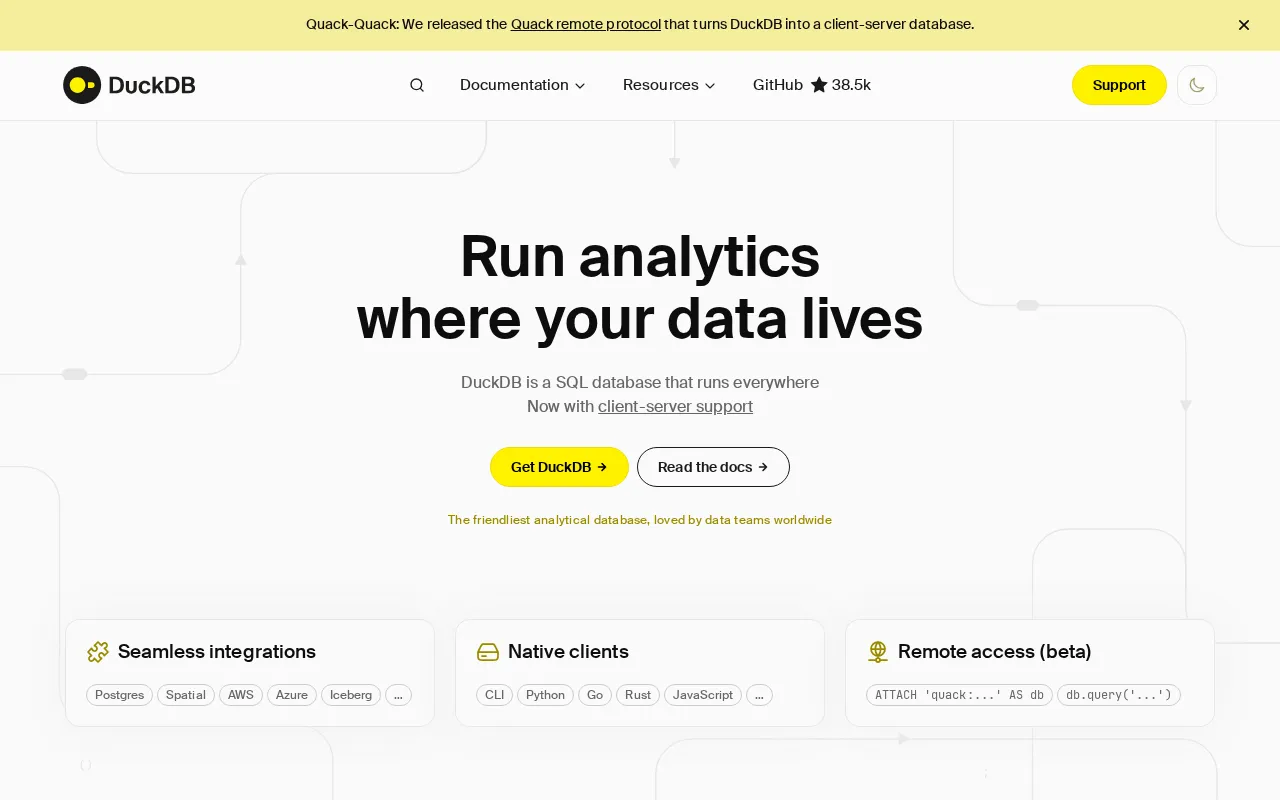
DuckDB plans and pricing
Open Source
This plan is ideal for all users, from individual developers to large enterprises, seeking a powerful, in-process analytical database
DuckDB pricing: the quick answer
DuckDB is free as of July 8, 2026. It ships under the MIT license as a single open-source build with no paid tiers, no subscription, and no per-seat cost. You embed it in-process inside Python, R, or any application and query Parquet, CSV, and JSON directly, including files on S3, without standing up a server. The one caveat is that DuckDB is an analytical engine, not a multi-user transactional database, so it does not handle concurrent writes the way Postgres or MySQL do. A managed cloud version, MotherDuck, exists as a separate service with its own pricing that DuckDB does not set.
- Open SourceFree
DuckDB is free to start, against a $82.76/mo median across 6 databases tools we track.
DuckDB pricing, read against its live plans and category
Positioning
DuckDB is free under the MIT license, and that is the whole pricing story. There is one build, no feature-gated tiers, and no subscription. You get vectorized execution and direct querying of Parquet, CSV, and JSON, including files on S3, without running a server. For a team analyzing datasets under a terabyte, it removes the need for a cloud data warehouse entirely, which is a rare thing to say about a database.
Cost drivers
- 1None from DuckDB itself. There are no overage charges, add-ons, or license fees. The only real cost is the compute you run it on, which is whatever laptop or VM you already have.
- 2A managed cloud option, MotherDuck, exists as a separate paid service with its own pricing. That is a different product, not a DuckDB tier.
Watch-outs
The common mistake is reaching for DuckDB as a general-purpose database. It runs in-process and is built for analytics, so it does not serve concurrent writes or act as a shared multi-user production store.
Strengths
- Runs in-process with zero infrastructure setup
- Queries Parquet and CSV on S3 directly, no ETL
- Beats many server-based databases on single-machine workloads
Editor’s take
Data scientists, analysts, and startups running analytical workloads under a terabyte should just use it; there is nothing to buy and nothing to negotiate. If you actually need a multi-user transactional database rather than a local analytical engine, PostgreSQL is the open-source engine to reach for instead.
 Oleh KemFounder & Lead Analyst
DuckDB Hidden Costs & Pitfalls
List price covers the subscription. Total cost of ownership for DuckDB typically includes additional line items that don't appear on the pricing page.
DuckDB price history
Cheaper Databases tools



Frequently asked questions
Sources & verification
| Source | What was checked | Last checked |
|---|---|---|
| Official Pricing Page | Source of verified tiers | July 8, 2026 |
| Official Website | Official vendor website | — |
| PeerSpot | PeerSpot enterprise peer reviews | — |
Every fact on this DuckDB pricing page is tied to a named source and a verification date. Freshness-sensitive figures trace to the sources above; verify against the vendor before relying on them.
Explore DuckDB
Every page on DuckDB in one place, you are on pricing.