
Databricks Pricing: Plans & Cost Calculator 2026
Custom pricing is tailored to your usage, starting with a free tier for basic workloads. Snowflake is the main alternative for SQL.
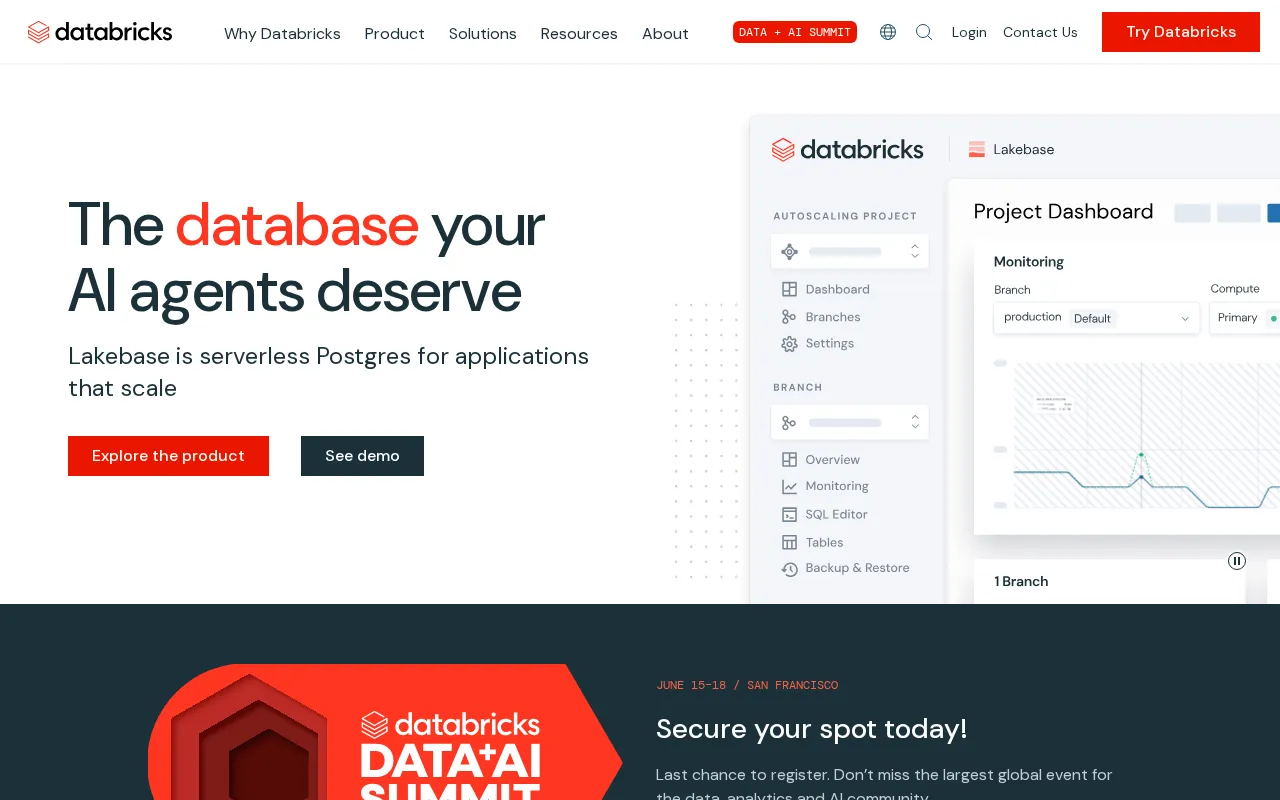
Databricks plans and pricing
Operational Database
Serving data & features for apps
Artificial Intelligence
AI compute (Genie / enterprise knowledge)
Genie
AI assistance across code, analytics & knowledge
Data Engineering
Jobs & pipelines (Lakeflow)
Data Warehousing
SQL warehousing
Interactive Workloads
Interactive classic & serverless compute
Databricks pricing: the quick answer
Databricks has no flat plan price; you pay per Databricks Unit as of July 8, 2026, and the rate depends on the workload. Data engineering starts at $0.15/DBU, data warehousing at $0.22/DBU, interactive workloads at $0.40/DBU, AI workloads at $0.07/DBU, and the operational database at $0.069 per compute unit. There is no single plan to pick: total spend is the sum of DBU usage across every product you run. On top of the DBU charge, your cloud provider bills the underlying VMs and storage separately, so a Databricks bill is really two bills. Committed-use contracts trade volume for a discount.
- Operational Database$0.07/mo
- Artificial Intelligence$0.07/mo
- Genie$0.07/mo
- Data Engineering$0.15/mo
- Data Warehousing$0.22/mo
- Interactive Workloads$0.40/mo
At $0.07/mo to start, Databricks sits 100% below the $82.76/mo median across 6 databases tools we track.
Databricks cost calculator
Databricks Hidden Costs & Pitfalls
The DBU rate is only the Databricks side of the invoice. The costs that surprise teams come from what those rates do not include and from a second bill entirely.
Databricks pricing, read against its live plans and category
Positioning
Databricks does not sell plans, it sells compute by the Databricks Unit, and the rate tracks the workload. Data engineering starts at $0.15/DBU, data warehousing at $0.22/DBU, interactive workloads at $0.40/DBU, AI at $0.07/DBU, and the operational database at $0.069 per compute unit. Everything is billed per second with no upfront cost, and your total is the sum of usage across every active product. For a shop that genuinely needs data engineering, SQL analytics, and ML in one place, that flexibility earns its keep. For a plain relational workload, it is more machinery than the job needs.
Cost drivers
- 1Two bills, not one. The DBU rate is the Databricks charge; the underlying VMs and storage are billed separately by AWS, GCP, or Azure, and that side often exceeds the Databricks side.
- 2Rate depends on workload. Interactive compute at $0.40/DBU costs nearly triple batch data engineering at $0.15/DBU, so where you run work matters as much as how much you run.
- 3Platform features are add-ons. Governance, managed services, storage, and connectivity are separate tiers; Genie bills $0.07/DBU beyond its free allotment.
Watch-outs
The combined bill is hard to predict, and users report the cloud-infrastructure portion running well past the Databricks fees themselves.
Strengths
- Lakehouse architecture removes ETL between data lake and warehouse
- MLflow is the de facto ML experiment-tracking standard
- Unity Catalog gives unified governance across data and AI
Editor’s take
Databricks SQL Serverless and Pro suit large teams that need high-concurrency BI alongside ML and heavy data engineering, and Committed Use Contracts are the lever for cutting the per-DBU rate at volume. For a smaller shop with a plain relational need, the two-invoice model is a lot to manage; PostgreSQL is the more predictable choice.
 Oleh KemFounder & Lead Analyst
Databricks price history
Cheaper Databases tools

Frequently asked questions
Sources & verification
| Source | What was checked | Last checked |
|---|---|---|
| Official Pricing Page | Source of verified tiers | July 8, 2026 |
| Official Website | Official vendor website | — |
| G2 | G2 verified user reviews · 4.6/5 · 768 reviews | — |
| Capterra | Capterra verified user reviews · 4.5/5 | — |
| TrustRadius | TrustRadius verified reviews | — |
| PeerSpot | PeerSpot enterprise peer reviews | — |
Every fact on this Databricks pricing page is tied to a named source and a verification date. Freshness-sensitive figures trace to the sources above; verify against the vendor before relying on them.
Explore Databricks
Every page on Databricks in one place, you are on pricing.