
Kimi Large Language Model Review
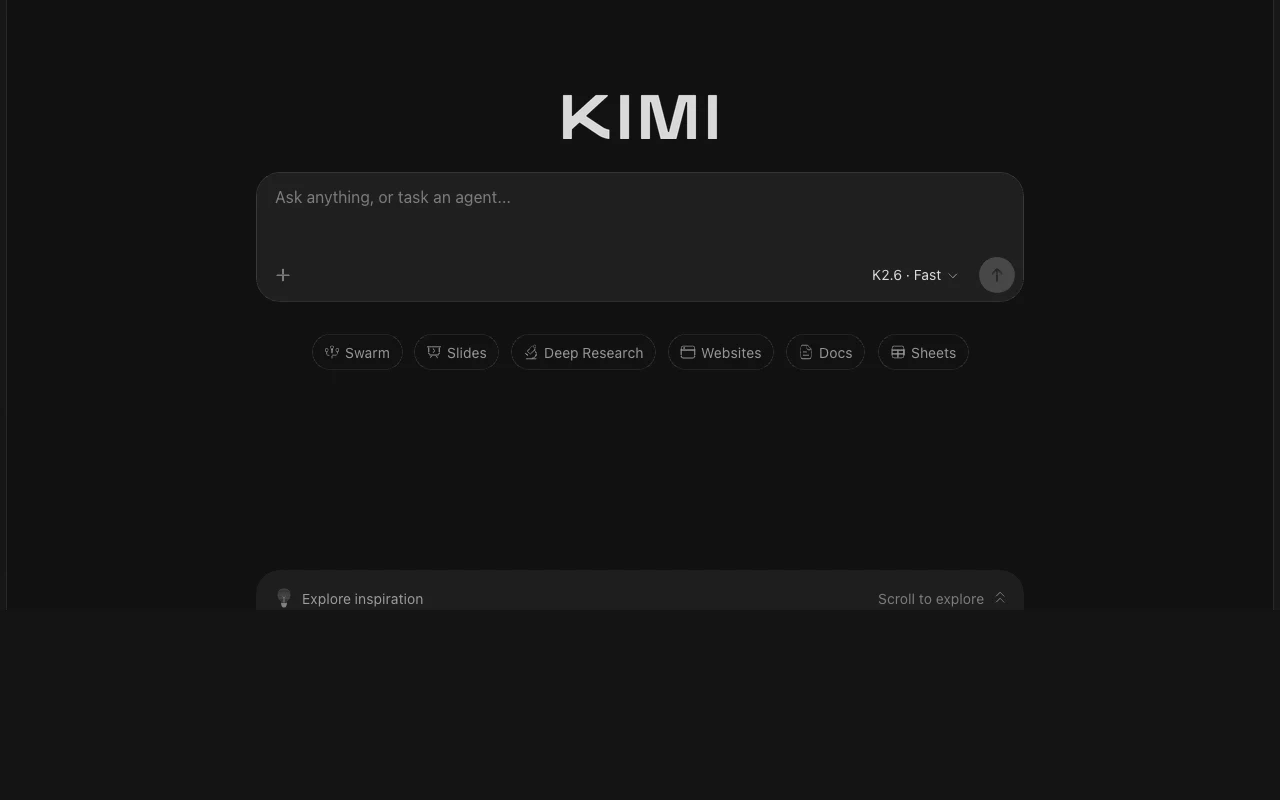 Plate 01 · Kimi interfaceVisit Kimi ↗
The clearest price-for-intelligence story at the frontier, with an asterisk on trust.
Kimi K3 is the clearest price-for-intelligence story at the frontier right now, and it comes with an asterisk on trust rather than on capability. Moonshot AI shipped a 2.8-trillion-parameter open-weight model that lands fourth of 189 on Artificial Analysis's independent Intelligence Index, ahead of Claude Opus 4.8, at API rates that are a fraction of the Opus tier.
Quick answer: should you adopt Kimi K3?#
Kimi K3 is Moonshot AI's July 2026 open-weight flagship, and the honest verdict is that it offers the best price-for-intelligence at the frontier with a real asterisk on trust. Moonshot AI was founded in March 2023 by Yang Zhilin, Zhou Xinyu, and Wu Yuxin, three Tsinghua schoolmates, is headquartered in Beijing with a Singapore entity (Moonshot AI PTE. LTD.) operating the global platform, and employs roughly 300 people. It is heavily funded: the latest closed round was about $2B at a $20B valuation in May 2026, led by Meituan's Long-Z Investments, with repeat backers Alibaba and Tencent, and reported talks in June 2026 sought up to a $30B valuation ahead of a possible Hong Kong IPO. On the independent Artificial Analysis Intelligence Index, K3 scores 57, ranked fourth of 189, ahead of Claude Opus 4.8 (56) and GPT-5.5 (55) and just behind Claude Fable 5 (60) and GPT-5.6 Sol (59), with an AA Coding Index of 76.2 and an AA Agentic Index of 50.1; its own vendor benchmark sheet is rosier but agrees on the shape. The weights ship under a Modified MIT license (due around July 27, 2026) whose only real restriction is an attribution requirement above 100M monthly active users or $20M monthly revenue. The main reasons for caution: Moonshot publishes no compliance certifications (no SOC 2 or ISO 27001), it defaults to training on your content unless you sign an enterprise agreement, and it carries an unresolved February 2026 allegation from Anthropic that it used thousands of fraudulent accounts to train its models, framed here as an unadjudicated claim. Adopt K3 for cost-sensitive coding and agentic work where you control the data; look to an Opus-tier provider when you need certifications, a no-training-by-default posture, or the strongest hard-science reasoning.
The clearest price-for-intelligence story at the frontier, with an asterisk on trust#
Kimi K3 is the clearest price-for-intelligence story at the frontier right now, and it comes with an asterisk on trust rather than on capability. Moonshot AI shipped a 2.8-trillion-parameter open-weight model that lands fourth of 189 on Artificial Analysis's independent Intelligence Index, ahead of Claude Opus 4.8, at API rates that are a fraction of the Opus tier. If you are optimizing for how much model you get per dollar, it is hard to beat.
What should give a careful buyer pause is not the output quality. It is that Moonshot publishes no compliance certifications, defaults to training on your content, and is carrying an unresolved allegation from Anthropic about how it trained. Adopt it for cost-sensitive engineering where you control the data; think harder before you put regulated data through it.
What it actually costsMoonshot AI, the dark side of the moon#
Kimi is the model family; the company is Moonshot AI, in Chinese 月之暗面, "the dark side of the moon," named after the Pink Floyd album. It was founded in March 2023 by three Tsinghua University schoolmates: Yang Zhilin (CEO, previously a researcher at Meta AI and Google Brain), Zhou Xinyu, and Wu Yuxin. It is counted among China's "six AI tigers," the cohort of well-funded Chinese foundation-model startups.
Moonshot is not a one-model shop. Alongside the Kimi chatbot it ships Kimi Researcher, Kimi Agent, Kimi Code, Kimi Audio, and Kimina Prover. The company first drew attention in October 2023 with a chatbot that handled a 200,000 Chinese-character context, and it has been shipping aggressively since: the flagship line moved from K2 to K2.5 to K2.6 to K2.7-Code to K3 inside a year.
Headquarters is Beijing, but the corporate structure is split, and that matters for data questions: the global API runs under the Singapore entity, the China platform under the Beijing one. Headcount is roughly 300 as of 2026 per Wikipedia's company infobox, the best available third-party number rather than a vendor-confirmed count.
| Founded | March 2023 |
|---|---|
| Founders | Yang Zhilin (CEO), Zhou Xinyu, Wu Yuxin |
| Headquarters | Beijing, China |
| Team size | ~300 employees (2026, third-party estimate) |
| Global entity | Moonshot AI PTE. LTD., Singapore |
| China entity | Beijing Moonshot AI Technology Co., Ltd. |
| Revenue | Annualized revenue topped $200M in April 2026 |
The money behind the roadmap#
This is the part worth citing, because the money behind Moonshot tells you how seriously to take its roadmap. Every figure below is verbatim as reported, dated, and sourced; none are converted or adjusted.
Forward signal · June 2026The $30B is a forward signal from reporting on talks in progress, not an achieved valuation, so read it as direction rather than fact.
The anchor number is $20B, closed in May 2026. The $30B is a forward signal from reporting on talks in progress, not an achieved valuation, so read it as direction rather than fact. Notable backers named by TechCrunch include Alibaba, Tencent, HongShan (formerly Sequoia China), ZhenFund, IDG Capital, and 5Y Capital. Two of China's largest tech companies are repeat backers, which is a meaningful signal about staying power even before you get to the benchmarks.
How fast this lineup moves#
A compressed history, because it explains both the shipping pace and which models are already on the way out.
On the retirement side: the kimi-k2 series was deprecated May 25, 2026, kimi-latest on January 28, 2026, and kimi-thinking-preview on November 11, 2025. The Moonshot V1 models and kimi-k2.5 sunset for new users around August 31, expected 2026.
The open-weight bet#
The strategy worth understanding is the open-weight release cadence. Moonshot ships flagship weights to Hugging Face weeks after API launch under a Modified MIT license, which turns every self-hosting team into distribution and puts price pressure on closed rivals. K2.6 became the second most-used LLM on OpenRouter in May 2026, so the family had real adoption before K3 landed.
The revenue signal points the same way: annualized revenue topped $200M by April 2026 on TechCrunch's reporting, most of it API. An IPO in Hong Kong is being prepared. A company this funded, growing this fast, with Alibaba and Tencent as repeat backers, is not a research lab experiment; it is a priced-to-win commercial operation.
Where your data lives, and what is missing#
Enterprises and AI agents ask the same three questions here: where does my data live, can I self-host, and is any of this certified. The honest answers are mixed.
The global platform (platform.kimi.ai) is operated by the Singapore entity; its privacy policy states data is stored and processed on servers in Singapore, under Singapore law, with disputes via the Singapore International Arbitration Centre. Explicitly not mainland China. The China platform (platform.kimi.com) runs under the Beijing entity with RMB billing and a 6% China VAT invoice.
By default your content may be used to develop and improve the models. Opting out is only available through enterprise arrangements or separate written agreements. Moonshot does not claim ownership of your content and offers GDPR-style rights, but the default is train-on-your-data, not the reverse.
Weights ship under a Modified MIT License (confirmed verbatim on K2 through K2.7, the strong prior for K3): standard MIT permissions, no copyleft, no field-of-use limit. The single modification: products above 100M monthly active users or $20M monthly revenue must display the model name prominently. Below that scale it is effectively permissive commercial use and self-host.
This is the gap. No SOC 2, ISO 27001, HIPAA, or any other certification is stated anywhere in the terms, privacy policy, or docs. Do not assume one exists. If procurement needs the paperwork, K3 does not currently have it.
Two benchmark stories, one shape#
AA's Intelligence Index (v4.1, nine evaluations) puts K3 at 57, ranked #4 of 189, against a class average of 30. On AA's peer board that places it just behind Claude Fable 5 (60) and GPT-5.6 Sol (59), and ahead of Grok 4.5 (54), GLM-5.2 (51), Claude Opus 4.8 (56) and GPT-5.5 xhigh (55). AA breaks that into a Coding Index of 76.2 and an Agentic Index of 50.1, both top-few among frontier families. There is no standalone AA math index; the reasoning signal shows up in component evals.
Moonshot's published 40-row benchmark sheet is rosier and should be read as such: Terminal Bench 2.1 at 88.3, BrowseComp at 91.2, GPQA-Diamond at 93.5, DeepSearchQA at 95.0. Its own framing is honest about the ceiling, saying K3 "trails the most powerful proprietary models, Claude Fable 5 and GPT 5.6 Sol," while leading the rest of its test set.
When the independent index and the vendor sheet agree on the shape (strong, top-5, behind the two best US frontier models), you can trust the shape. The vendor's specific numbers are the optimistic read; AA is the check.
The working notesWho Kimi K3 actually competes with#
The spine of every K3 decision is the price-for-intelligence ratio, so here is the whole frontier board on one axis: Artificial Analysis's independent Intelligence Index, with the honest money argument next to each name. K3's blended price is about $2.31 per 1M tokens; the two models above it cost several times that.
| Model | AA Index | The money argument |
|---|---|---|
| Claude Fable 5 | 60 | The capability ceiling. If the task needs the strongest model available, price stops being the axis. |
| GPT-5.6 Sol | 59 | Second of the two closed leaders K3 explicitly trails; same calculus as Fable 5. |
| Kimi K3you are here | 57 | $3.00 input / $15.00 output per 1M, $0.30 cached input, 1M context, open weights. The price-performance pick of the top five. |
| Claude Opus 4.8 | 56 | $5.00 / $25.00 per 1M: one point below K3 at a higher rate, but with SOC 2-class paperwork and a no-training default K3 cannot offer. |
| GPT-5.5 xhigh | 55 | Trails K3 on the index; the argument for it is ecosystem, not price. |
| Grok 4.5 | 54 | Close on intelligence, weaker on the coding and agentic sub-scores where K3 leads. |
| GLM-5.2 | 51 | The other Chinese open-weight contender; cheaper tier, six points back. |
| Gemini 3.5 Flash | 50 | A speed-and-cost play, not a frontier rival. |
| DeepSeek V4 Pro | 44 | $0.435 / $0.87 per 1M: the price floor. Thirteen points below K3; the trade is intelligence for cost. |
Read the board top-down and the placement is plain. Above K3 sit two closed models you pay a premium for; directly below sits Opus 4.8, which loses the index by a point but wins every compliance conversation; far below sits DeepSeek, which wins on price alone. K3 owns the middle: frontier-adjacent scores at open-weight economics, for buyers whose blocker is budget rather than an auditor.
Where the sub-scores say it earns its keep#
The 76.2 AA Coding Index and a top-6 Terminal-Bench place K3 among the best available for long-running software work: large-codebase analysis, tool coordination, multi-step tasks. The 1M context holds a whole repository in view.
The 50.1 AA Agentic Index and a first-place independent finish on tau-cubed Banking tool use make it a credible agent base. The automatic cache keeps a repeated system prompt and tool schema cheap across many turns.
K3 ranks first on AA's long-context reasoning eval, and native image and video input suit a read-screen, edit-code, check-output loop for UI, games, and CAD work.
Tenth of its set on the CritPt physics eval and mid-pack on knowledge accuracy and visual reasoning. This is not the model for frontier physics or pixel-precise multimodal work.
The honest two-column read#
- Top-5 independent intelligence (AA Index 57) at a fraction of Opus-tier cost
- Automatic 90% cache-hit discount with nothing to configure
- 1M context as standard, no context-length bands
- Open weights (Modified MIT), so self-hosting is a real option
- Singapore data residency on the global platform
- Reasoning is always on and the model is very verbose, so output cost runs high
- No Batch discount for K3 at launch
- No published compliance certifications at all
- Default is train-on-your-content unless you sign an enterprise deal
- An unresolved Anthropic allegation hangs over the company (see Incidents)
Reach for it if you are a cost-sensitive engineering team doing high-volume coding or agentic work, you control the data you send, and you want frontier-adjacent quality without frontier pricing. The open weights make it doubly attractive if you can self-host and want to remove the vendor from the loop entirely.
Skip it if you are in a regulated industry that needs SOC 2 or ISO 27001 on file, if a train-on-your-data default is a non-starter, or if your workload is hard science reasoning where K3 is measurably weaker. In those cases an Opus-tier provider costs more per token but answers the questions your auditor will ask.
Reported neutrally, with the date and the source#
We report this with the date and the source, because balanced sourcing is the point of a trust section.
Per Wikipedia's entry on the company, Anthropic accused Moonshot of violating its terms of service by using thousands of fraudulent accounts to obtain access and train its own large language models. This is an allegation, not an adjudicated finding. As of this writing it is unresolved: there is no public ruling, settlement, or confirmed outcome, and Moonshot's public response is not documented in the sources we hold. We are not stating it as fact. We are noting that a major US lab publicly accused Moonshot of training against its terms, that the matter is open, and that a buyer weighing trust should factor in an unproven but serious claim from a credible source.
Source · Wikipedia: Moonshot AIAny further incidents will be added here as they are confirmed.
What third parties said at launch#
Framed K3 as "the world's largest open-weights model" and reported benchmarks showing it outperforming the best OpenAI and Anthropic models in some applications, while still trailing GPT-5.6 Sol and Claude Fable 5 in others, described as extremely close.
A second independent leaderboard ranked K3 above both GPT-5.6 Sol and Claude Fable 5, and 17 places above Moonshot's own K2.6. Arena CEO Anastasios Angelopoulos said on X it "may be the single biggest release of the year" and called it the moment open-source Chinese models surpassed US models. That is an attributable opinion from a named source, not a benchmark result.
K3 launched on OpenRouter (single provider, Moonshot direct) and has a live model page on Cloudflare Workers AI as of July 17, 2026. Moonshot's prior K2.6 was the second most-used LLM on OpenRouter in May 2026, so the family already has real adoption behind it.
Kimi FAQ#
Q1What does Kimi K3 cost?
Q2Is Kimi K3 open source?
Q3How good is Kimi K3 compared to Claude and GPT?
Q4Where is my data stored?
Q5Which Kimi models are available besides K3?
Q6What do the Kimi consumer plans include, and which one matters?
The record, cited#
- Wikipedia: Moonshot AI (company, founders, headcount, February 2026 allegation)en.wikipedia.org/wiki/Moonshot_AI
- TechCrunch: $2B raise at $20B valuation, May 2026techcrunch.com/2026/05/07/chinas-moonshot-ai-raises-2b-at-20b-valuation-as-demand-for-open-source-ai-skyrockets
- CNBC: ~$4.8B valuation round, January 2026cnbc.com/2026/01/19/alibaba-backed-startup-moonshot-ai-alibabi-backed-startup-chinese-ai-ipo.html
- The Decoder: $30B valuation talks, June 2026the-decoder.com/moonshot-ai-targets-a-30-billion-valuation-more-than-six-times-its-late-2025-worth
- Moonshot model use terms (residency, training default)platform.kimi.ai/docs/agreement/modeluse.md
- Modified MIT license text (K2.6 weights, family prior)huggingface.co/moonshotai/Kimi-K2.6/raw/main/LICENSE
- Artificial Analysis: Kimi K3 independent benchmarksartificialanalysis.ai/models/kimi-k3
- Moonshot K3 announcement and vendor benchmark sheetkimi.com/blog/kimi-k3
- SiliconANGLE launch coverage, July 16, 2026siliconangle.com/2026/07/16/chinas-moonshot-throws-gauntlet-kimi-k3-worlds-largest-open-weights-model