
Best IBM Turbonomic Alternatives in 2026
Zesty offers a free tier to challenge Turbonomic, which hides pricing behind sales calls. Switch when you need transparent, self-serve billing for your finops.
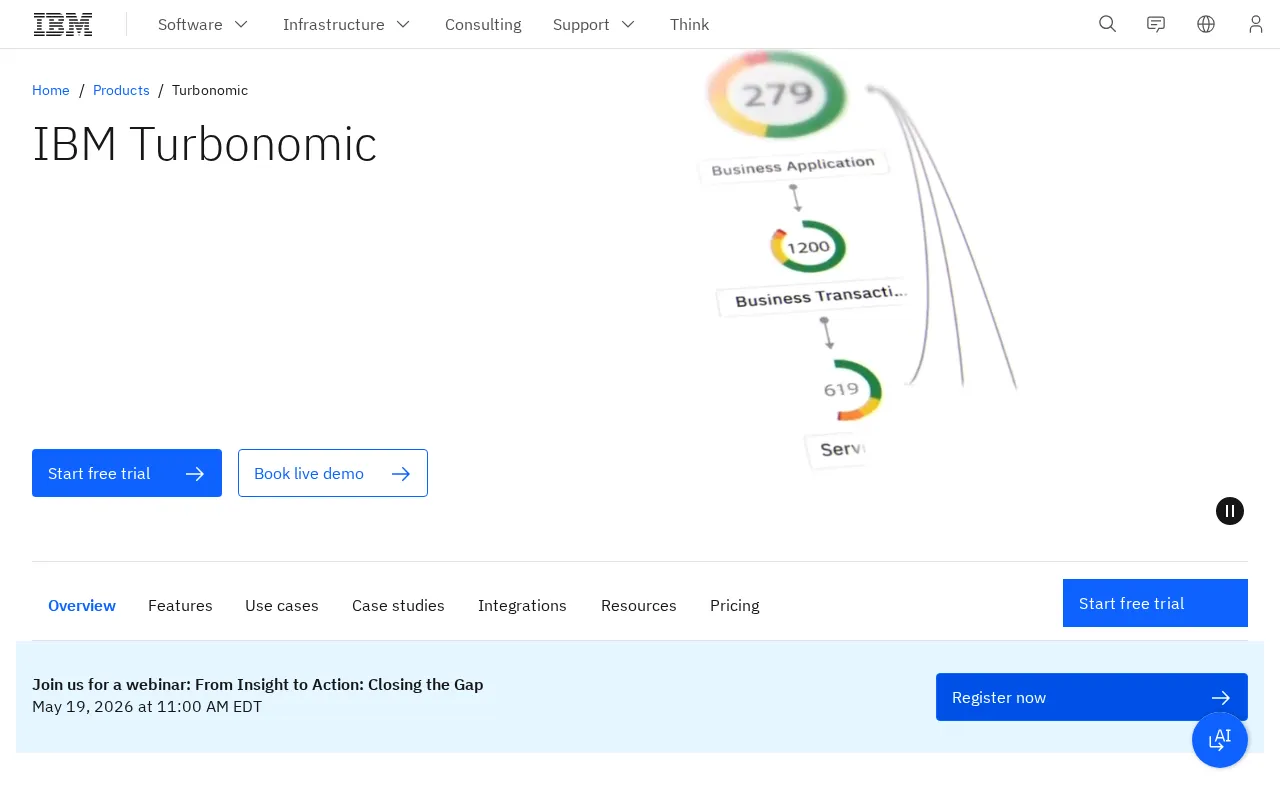
Feature Overview: Top IBM Turbonomic Alternatives
IBM Turbonomic compared against all 10 finops & cloud cost alternatives. Pricing, free plan availability, rating, and finops & cloud cost-specific capabilities.
| Tool | Price | Free Plan | Rating |
|---|---|---|---|
 | Custom | No | 4.4G2 |
 | Custom | No | 4.8G2 |
 | $30/mo | 4.7G2 | |
 | Custom | No | 4.6G2 |
 | Free | 4.6G2 | |
 | Pay-as-you-go | 4.5G2 | |
 | $250/mo | 4.5G2 | |
 | Pay-as-you-go | 4.2G2 | |
 | Contact sales | No | 4.3G2 |
 | Pay-as-you-go | No | 4.1G2 |
 | Pay-as-you-go | No | - |
How Does IBM Turbonomic Compare to Alternatives?
Independently verified metrics. Sources: Vendor documentation, independent research. Verified 2026.
| Tool | Avg Savings% | Cost Allocation% | Alert Timemin | Cloud Providers |
|---|---|---|---|---|
| Zesty | 0.45% | - | - | 5 |
| Vantage | 20% | 90% | 60 | 15 |
| CloudZero | 25% | 0.95% | 5 | 10 |
| CAST AI | 0.5% | 85% | 1 | 10 |
| IBM Kubecost | 30% | 0.9% | 5 | 5 |
When Should You Stick with IBM Turbonomic?
Alternatives are not always the right move. IBM Turbonomic remains strong in these scenarios.
- +Unique performance-aware resource optimization prevents SLA degradation
- +AI proactively right-sizes resources before problems occur
- +Covers hybrid cloud + on-prem VMware environments
- +IBM backing adds enterprise reliability and APM integration
- -We're still evaluating the solution, so I don't know enough about what I don't know.
- -Turbonomic can modernize the look and feel, making it more user-friendly to access and obtain information.
- -It can be more agnostic in terms of the solutions that it provides.
- -I would like Turbonomic to add more services, especially in the cloud area.
IBM Turbonomic Alternatives by Cloud Stack
10 alternatives evaluated by features, pricing, and real-world use cases.
Expert Take
Turbonomic is the coverage leader, ticking every capability column, yet IBM's own page prices nothing: a 30-day trial, then quotes. The one public number lives on AWS Marketplace, the Turbonomic SaaS listing at $37,909.82 a year for 200 managed virtual servers, with a $22.60 per-unit overage.
 Oleh KemFounder & Lead Analyst
Automated cloud cost optimizer for storage and compute with real-time resource resizing.. Rated 4.9/5 vs 4.5/5 for IBM Turbonomic.
- +Performance-based pricing: zero risk, pay from savings
- +Automated RI and Savings Plans management eliminates waste
- +EBS auto-scaling reduces storage costs 70%+
- +Fully automated with zero manual intervention
- +Automated Reserved Instance Management
- +EBS Volume Auto-Scaling
- +RDS Optimization
- +Savings Plans Management
- −I find myself using the online editor the most often, and what would be better is if you could have multiple windows open to work
- −There are different resource types that we would like to leverage and get reserved instances for, such as RDS instances.
- −I would like to get RDS-reserved instances that I could buy and sell, but that's a limitation on AWS.
A multi-cloud and SaaS cost management platform that provides granular visibility and automated savings for engineering . Rated 4.8/5 vs 4.5/5 for IBM Turbonomic.
- +Integrates SaaS costs like Datadog, Snowflake, and MongoDB Atlas
- +Autopilot feature automatically purchases Savings Plans and RIs
- +Per-resource cost visibility without complex tagging requirements
- +Generous free tier with unlimited users and connected accounts
- +Modern, engineer-friendly UI simplifies cost exploration
- +Per-Resource Cost Reporting
- +Cost Allocation (Teams/Apps)
- −Lacks real-time, hands-on automated optimization like CAST AI
- −No support for Oracle Cloud Infrastructure (OCI) or on-prem costs
- −Native Kubernetes cost allocation is less granular than Kubecost
Unit cost intelligence platform connecting cloud spend to metrics like cost per customer and per feature.. Rated 4.7/5 vs 4.5/5 for IBM Turbonomic.
- +Best unit economics analysis in FinOps category
- +CostFormation enables custom cost metrics in code
- +Cost-per-customer insight drives business decisions
- +Engineering-first approach aligns with DevOps culture
- +Unit Cost Analysis
- +Custom Cost Dimensions
- +Engineering Cost Allocation
- +Anomaly Detection
- −There is a need for UI improvements.
Automated Kubernetes cost optimization using continuous bin-packing and spot instance management.. Rated 4.7/5 vs 4.5/5 for IBM Turbonomic.
- +Automated Kubernetes optimization: not just recommendations
- +Performance-based pricing aligns incentives
- +50-60% Kubernetes cost reduction in customer reports
- +Free visibility tier to build trust before enabling automation
- +Kubernetes Autoscaling
- −Requires trust in automated infrastructure changes
- −Primarily Kubernetes-focused: limited for non-K8s workloads
Real-time Kubernetes cost monitoring and allocation by namespace, deployment, label, and team..
- +Open-source core trusted in thousands of clusters
- +Deep Kubernetes cost allocation (pod/namespace/label level)
- +Native Prometheus and Grafana integration
- −Visibility-only: no automated optimization like CAST AI
- −Multi-cluster requires paid tier
Shows cloud cost estimates for IaC changes directly in pull requests to prevent expensive infrastructure deployments..
- +Native CI/CD integration comments costs directly on pull requests
- +Supports Terraform, Terragrunt, Pulumi, and CloudFormation
- +Free, open-source CLI provides core cost estimation functionality
- +Shows cost impact of usage-based resources (e.g., Lambda, S3)
- +Defines FinOps policies as code to guardrail cloud spending
- +Terraform cost estimation
- −Cost estimates for usage-based resources can be inaccurate
- −Lacks support for non-IaC resources or manual cloud changes
- −Limited historical cost tracking and trend analysis in free tier
An enterprise-grade FinOps platform for multi-cloud cost allocation, optimization, and showback integrated with Apptio T. IBM Turbonomic edges it on ratings (4.5 vs 4.3/5).
- +Deep Apptio TBM integration for holistic IT financial planning
- +Granular cost allocation engine ideal for complex chargeback models
- +Mature RI & Savings Plan modeling based on years of historical data
- +Strong multi-cloud support across AWS, Azure, and GCP
- −UI/UX can feel dated and less intuitive than modern competitors
- −Limited real-time anomaly detection compared to newer platforms
- −Tag management and enforcement capabilities are less advanced
An enterprise Technology Business Management (TBM) platform for modeling, analyzing, and optimizing hybrid IT spending..
- +Industry-standard TBM taxonomy for benchmarking IT costs
- +Deep, native integrations with ServiceNow, SAP, and Oracle
- +Robust cost modeling for complex hybrid and multi-cloud estates
- +Automates IT chargeback and showback based on consumption data
- +Strong professional services and support ecosystem via IBM
- +Technology Business Management (TBM)
- +Cloud Cost Management
- +IT Budgeting & Planning
- −High total cost of ownership beyond licensing (implementation, services)
- −Legacy UI/UX can feel dated compared to modern cloud-native tools
- −Reporting and dashboard customization can be rigid and complex
Showing 8 of 10 alternatives
Common Questions About Switching from IBM Turbonomic
Sources & verification
| Source | What was checked | Last checked |
|---|---|---|
| Official Website | Official vendor website | — |
| G2 | G2 verified user reviews · 4.4/5 · 310 reviews | — |
| Capterra | Capterra verified user reviews · 4.4/5 | — |
| TrustRadius | TrustRadius verified reviews | — |
| PeerSpot | PeerSpot enterprise peer reviews | — |
Every fact on this IBM Turbonomic pricing page is tied to a named source and a verification date. Freshness-sensitive figures trace to the sources above; verify against the vendor before relying on them.