
Railway Performance: Benchmarks, Latency & Limits 2026
Railway is usage-metered per vCPU-minute, always-on with no cold starts. Independent tests saw 381ms average at 99.991% uptime. Serverless sleeping is opt-in.
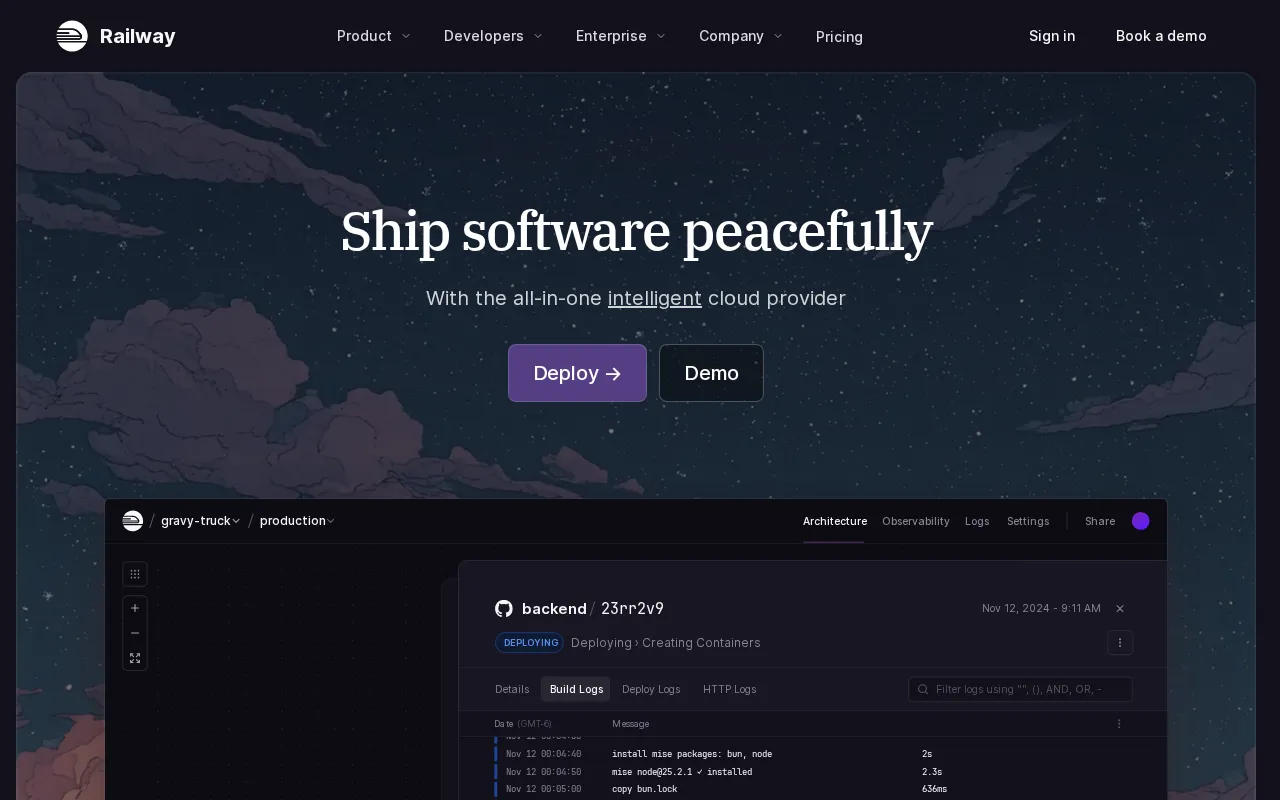
Railway Performance verdict
Railway is usage-metered, not tier-priced.
You pay $0.000463 per vCPU-minute and $0.000231 per GB-minute, roughly $20 and $10 a month, scaling vertically to plan limits by default and horizontally with manual replicas. Independent OpenStatus monitoring put it at 381ms average with 99.991% uptime and no cold starts, since services stay always-on unless you opt into Serverless sleeping.
Size vCPU and RAM to the real working set, because you pay by the minute for what you allocate, and an idle always-on service still accrues minutes. Use multi-region replicas to cut latency for distant users. Turn on Serverless sleeping for low-traffic services to stop paying while idle, accepting a cold-boot first request. There is no autoscaling trigger, so horizontal scaling means setting a replica count by hand. Keep replicas stateless, since there are no sticky sessions.
- Cost is usage-based, so an idle always-on service still accrues vCPU and RAM minutes. Serverless sleeping or fewer replicas cut the bill.
- There is no autoscaling trigger, so horizontal scaling means manually setting a replica count. Railway does not support sticky sessions, so design stateless replicas.
- OpenStatus tested the free plan in a single region, so latency tracks the distance to your chosen region.
- Avg latency (independent)
- 381 ms
- Uptime (independent)
- 99.991%
- CPU rate
- $0.000463/vCPU-min
- Per-replica max (Pro)
- 24 vCPU
- Cold starts
- None (always-on)
This page covers how fast Railway runs, how it scales and what it costs. Region coverage lives on its own page.
Estimate your Railway usage cost
- 1 × (1 vCPU + 1 GB) for 730 h/mo costs about $30.40/mo (67% CPU, 33% RAM), running always-on.
- Hobby includes $5/mo of usage and Pro includes $20/mo, on top of the base subscription.
Estimated from Railway's published per-minute rates ($0.000463/vCPU-min, $0.000231/GB-min). Egress and storage are billed separately. Verify against your own workload.
Railway measured latency, independent data
| Metric | Value | Sample |
|---|---|---|
| Average latency | 381 ms | free, us-west1, 10,955 pings |
| p75 latency | 469 ms | OpenStatus, Feb 2024 |
| p95 latency | 661 ms | OpenStatus, Feb 2024 |
| p99 latency | 850 ms | OpenStatus, Feb 2024 |
| TTFB, nearest probe | 65 ms | Ashburn (IAD) |
| TTFB, farthest probe | 319 ms | Johannesburg (JNB) |
| Uptime, two weeks | 99.991% | 1 fail / 10,955 pings |
Scaling and replicas
| Capability | Value | Notes |
|---|---|---|
| Vertical autoscaling | Default | Scales to the plan's vCPU and memory limits automatically |
| Horizontal scaling | Manual replicas | Increase replica count in service settings; no autoscaling trigger |
| Per-replica ceiling (Pro) | 24 vCPU / 24 GB | Split across replicas for more |
| Multi-region replicas | Nearest-region routing | Public traffic routes to nearest region, then random within it |
| Replica changes | Staged, no full redeploy | New replicas reuse the existing image; removed ones drain gracefully |
| Sticky sessions | Not supported | No session affinity across replicas |
Plan limits and billing rates
| Plan | Max vCPU / RAM | Replicas |
|---|---|---|
| Free | 1 vCPU / 0.5 GB | 1 |
| Trial | 2 vCPU / 1 GB | 2 |
| Hobby ($5/mo + usage) | 48 vCPU / 48 GB | 6 |
| Pro ($20/mo + usage) | 1,000 vCPU / 1 TB | 42 |
| Enterprise | 2,400 vCPU / 2.4 TB | 50 |
| Billing rate | $0.000463/vCPU-min, $0.000231/GB-min | Per minute |
Railway reliability and architecture
- Railway's infrastructure runs on Google Cloud Platform
- Railway is SOC 2 Type II and SOC 3 certified, with HIPAA available via a BAA add-on and a self-serve GDPR DPA
- Railway's Trust Center lists a 60-minute Recovery Time Objective
- Network security includes a firewall, spoofing protection and traffic filtering
- Railway publishes no explicit SLA uptime percentage; contractual SLAs are described as an Enterprise plan feature
- Independently, Railway recorded 99.991% uptime with a single failure across 10,955 pings over two weeks
Railway latency benchmarks, independently measured
- OpenStatus independently monitored a basic Hono server on Railway's free plan every 10 minutes from six global locations, gathering 10,955 pings over two weeks in February 2024
- Railway averaged 381ms with 99.991% uptime, second only to Cloudflare Workers (182ms) and ahead of Render (451ms), Koyeb (539ms) and Fly.io (1,471ms cold)
- No cold starts were observed because the Railway service stayed always-on by default rather than sleeping
- Per-region p99 stayed tight, from 131ms (Ashburn) to 893ms (Johannesburg), tracking distance to the deployment
- Railway opt-in Serverless (formerly App-Sleeping) sleeps a service after 10 minutes of inactivity, trading a possible cold-boot 502 for lower usage cost
- Cloudflare and Fastly serve as Railway's CDN subprocessors, and the CLI can enable CDN caching and an Under-Attack WAF mode
Railway Performance FAQ
How fast is Railway, and what do independent benchmarks show?
OpenStatus independently monitored a Hono server on Railway every 10 minutes from 6 global probes over two weeks in Feb 2024. It saw 381ms average, 469ms p75, 661ms p95, 850ms p99, and 99.991% uptime with a single failure in 10,955 pings. No cold starts appeared, because the service stayed always-on. Railway placed second only to Cloudflare Workers at 182ms, ahead of Render at 451ms and Fly.io at 1,471ms cold.
How does Railway bill for compute?
Usage-based, per minute: $0.000463 per vCPU-minute and $0.000231 per GB-minute, which works out to about $20 per vCPU and $10 per GB a month. There is no fixed instance price. Hobby at $5 a month includes $5 of usage, and Pro at $20 a month includes $20, beyond which you pay for what you consume. Egress at $0.05/GB and volume storage at $0.15/GB a month are billed separately.
How does scaling work on Railway?
Vertical autoscaling is on by default and grows a service to the plan's vCPU and memory limits. Horizontal scaling is manual: you set a replica count in service settings, up to 6 on Hobby, 42 on Pro, 50 on Enterprise. Each Pro replica can use up to 24 vCPU and 24 GB. Multi-region replicas route public traffic to the nearest region. There are no autoscaling triggers and no sticky sessions.
Does Railway have cold starts?
Not by default, since services run continuously, which is why the independent benchmark saw none. Railway's opt-in Serverless feature, formerly App-Sleeping, sleeps a service after 10 minutes without outbound traffic to cut usage cost. The first request then wakes it, with a short cold-boot that may return a 502. Leave Serverless off for latency-sensitive production services.
What reliability and compliance does Railway offer?
Railway runs on Google Cloud and recorded 99.991% uptime in the independent benchmark, with a 60-minute Recovery Time Objective. It is SOC 2 Type II and SOC 3 certified, offers HIPAA via a BAA add-on and a self-serve GDPR DPA, and is EU-US and Swiss-US DPF certified. There is no published SLA percentage, since contractual SLAs are an Enterprise feature.
Sources & verification
| Source | What was checked | Last checked |
|---|---|---|
| Railway Official | Official product page | July 10, 2026 |
| OpenStatus | Independent latency benchmark | July 10, 2026 |
| Railway Developer docs | Scaling and concurrency | July 10, 2026 |
| Railway Developer docs | Pricing and plans | July 10, 2026 |
| Railway Developer docs | Security and compliance | July 10, 2026 |
| Railway Developer docs | Deployments Serverless | July 10, 2026 |
| Railway Trust center | Product documentation | July 10, 2026 |
Every fact on this Railway page is tied to a named source and a verification date. Freshness-sensitive figures trace to the sources above; verify against the vendor before relying on them.
Explore Railway
Every page on Railway in one place, you are on performance.
Snapshot, score and verdict
Deployment targets, regions and data residency
You are here
Every tier and the entry price
Hidden fees, discounts and how to negotiate
Compared and ranked vs peers
Price and feature change history
Browse the full Cloud Hosting category