
Qdrant Review: Features, Pricing & Integrations 2026
From free to $65/mo and rated 4.5/5, this Rust-based database delivers top-tier search speed and multimodal named vectors, though clustering remains weak.
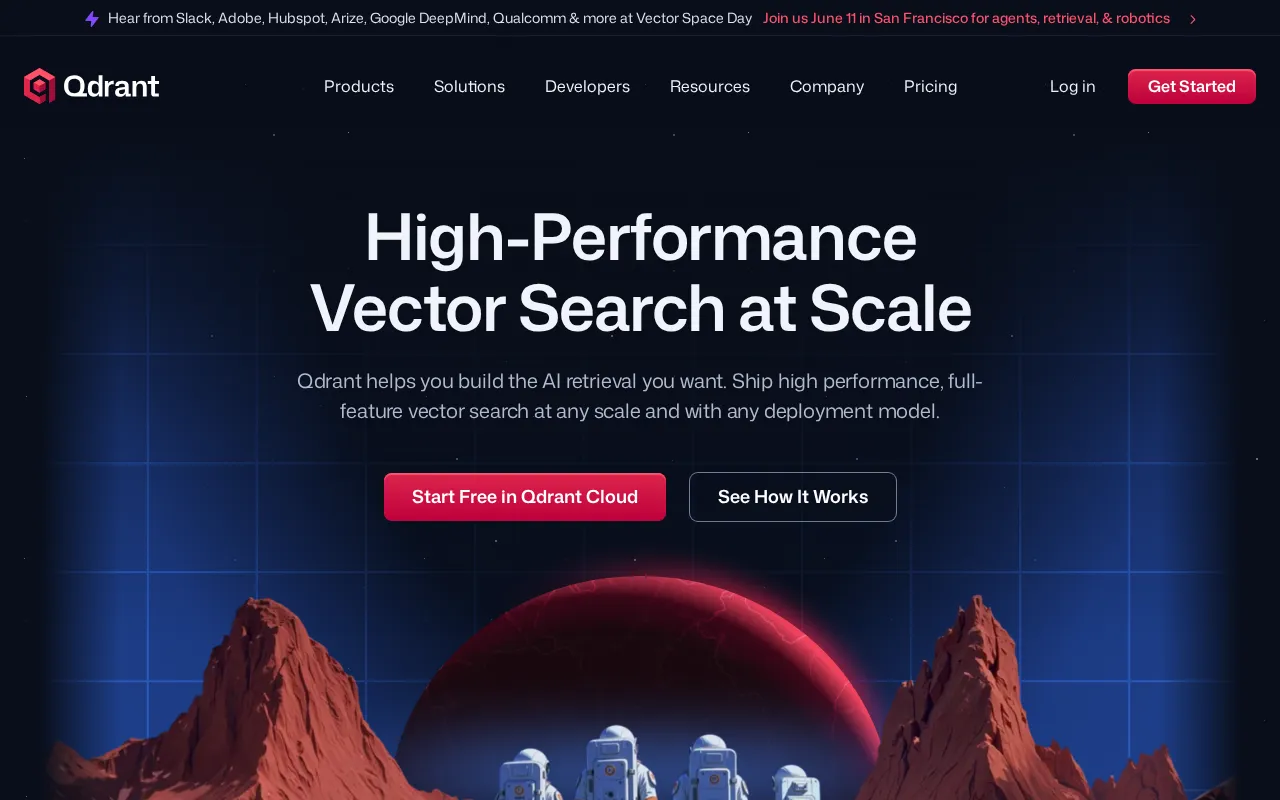
Expert Analysis of Qdrant
Self-hosting teams pay nothing at all, at any size, under Apache 2.0. Cloud buyers get no published unit rates: Qdrant meters CPU, memory and disk by the hour and sends you to a calculator. The free cluster has no failover and no shard rebalancing.
 Oleh KemFounder & Lead Analyst
Payload-Based Filtered Vector Search at Full Speed
Qdrant's HNSW indexes integrate payload filtering natively, executing filtered nearest-neighbor search without a post-filter scan step, maintaining sub-50ms latency on complex metadata filters.
Sparse Vector Support for Hybrid Lexical-Semantic Search
Qdrant supports sparse vectors natively alongside dense vectors, enabling BM25 and embedding search in the same collection for hybrid retrieval without maintaining two separate indexes.
On-Disk Indexing for Large Collections Without RAM Scaling
Qdrant's on-disk HNSW stores vectors on SSD while keeping only graph navigation data in RAM, serving collections larger than server memory at acceptable latency for cost-sensitive deployments.
Open Source (Self-Hosted)
Open SourceBest for: Ideal for users who prefer full control and self management of their vector database
- ✓Apache 2.0 licensed
- ✓Full data sovereignty
- ✓Runs on your own infrastructure
- ✓Zero licensing cost at any scale
Showing 3 of 6 plans. See all plans & API pricing →
Prices last verified July 8, 2026
Monitored Plans & Rates
Currently TrackingComparEdge is tracking Qdrant pricing. No price changes recorded since monitoring began.
The Final Verdict: Is Qdrant Right for You?
A top-rated vector databases tool with 16 features and a free plan - excellent for Teams needing fast, self-hosted vector search.
Top Pros
- Top benchmark performance via Rust and quantization
- Named vectors enable multimodal and complex search patterns
- Binary quantization reduces memory 32x
Watch Out For
- The area for improvement in Qdrant is its clustering capability.
Developer Integrations
Oleh KemFounder & Lead AnalystExpert verified·Updated July 8, 2026·Our methodologyFrequently Asked Questions About Qdrant
Explore More Vector Databases Tools for 2026






Sources & verification
| Source | What was checked | Last checked |
|---|---|---|
| Official Website | Official vendor website | — |
| Official Pricing Page | Source of verified tiers | July 8, 2026 |
| G2 | G2 verified user reviews · 4.5/5 · 12 reviews | — |
| PeerSpot | PeerSpot enterprise peer reviews | — |
Every fact on this Qdrant pricing page is tied to a named source and a verification date. Freshness-sensitive figures trace to the sources above; verify against the vendor before relying on them.
Explore Qdrant
Every page on Qdrant in one place, you are on overview.
You are here
Framework/SDK integrations for retrieval workloads
Latency, throughput, uptime and behaviour under scale
Every tier and the entry price
Compared and ranked vs peers
Price and feature change history
Browse the full Vector Databases category