
Glide SEO & Core Web Vitals 2026
Glide builds apps behind a login, not pages to rank. Its website mode was retired in 2023, and gated client-rendered apps expose no HTML for Google to index.
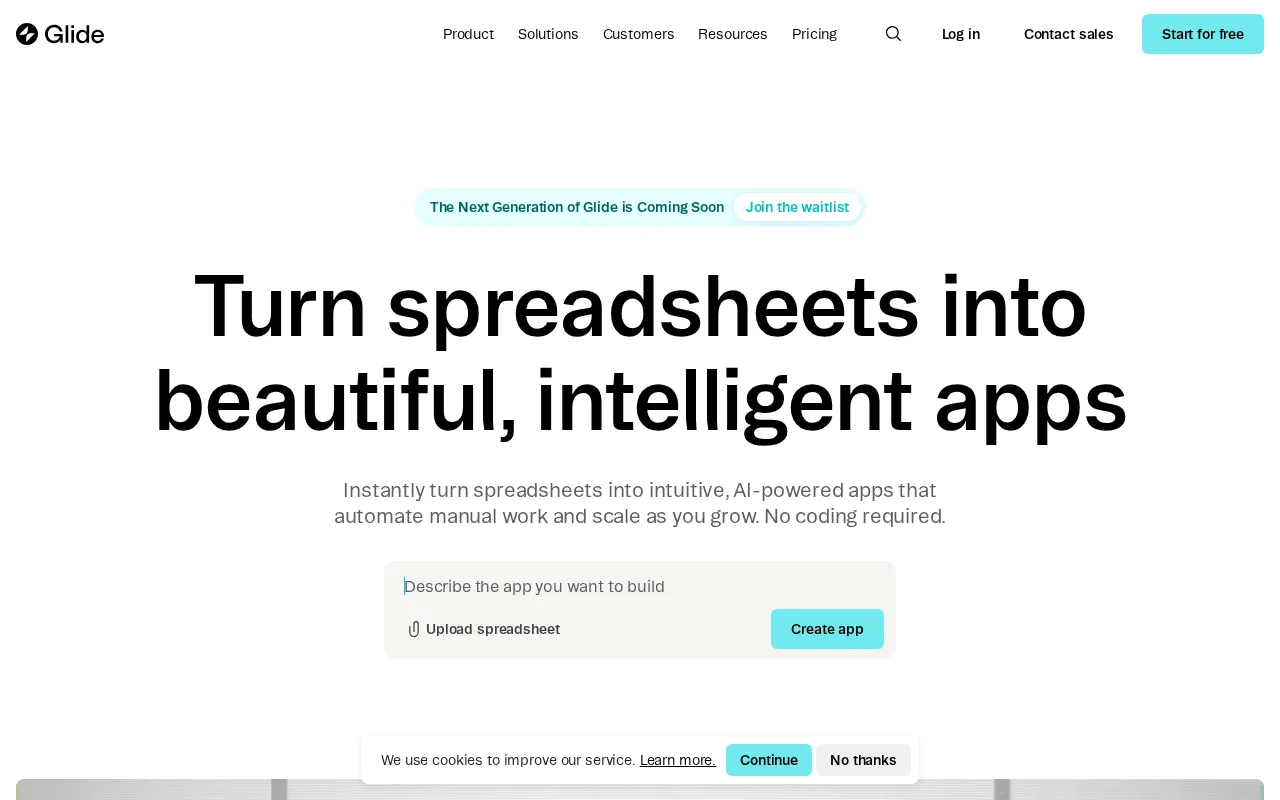
Glide SEO & Core Web Vitals verdict
Glide builds apps behind a login, not pages to rank.
The product makes automatically adaptive web apps that work across phone, tablet and desktop, and they sit behind a sign-in screen, so they are software rather than crawlable marketing sites. Glide Pages, the one mode that produced public web pages, was merged into Glide Apps and retired in March 2023.
Pick Glide for internal tools, member apps and software behind a login, where search traffic is not the point. It is a poor fit if you expected public, rankable marketing pages, since the website mode was retired and apps are gated. If you do need SEO, budget for a separate public frontend that renders Glide's data into real HTML.
- Glide apps are client-rendered and sit behind a sign-in screen, so most of the app is not exposed to crawlers as indexable HTML.
- The public-website mode, Glide Pages, was retired in March 2023, so there is no separate website builder, only adaptive web apps. Google indexes rendered HTML and will not render blocked or gated pages, which is exactly what a login-gated Glide app is.
- For organic search you build a separate public frontend fed by the Glide API, which only reaches Big Tables data.
- What it builds
- Gated web apps
- Public website mode
- Retired (Mar 2023)
- Indexable HTML
- Little (behind login)
- Native data source
- Glide Big Tables
- Path to SEO
- Separate frontend via API
This page covers Glide's SEO surface and app performance. Migration and pricing live on their own pages.
Can a site built here rank at all?
Glide builds automatically adaptive web apps that sit behind a sign-in screen, so the SEO question is not how a set of marketing sites scores on Core Web Vitals but whether a gated, client-rendered app is indexable at all. It mostly is not, and the public-website mode (Glide Pages) was retired in March 2023.
- Rendered HTML: a client-rendered Glide app exposes little public HTML for Google to index
- Gated content: apps sit behind a sign-in screen, and Google does not render blocked or gated pages
- Public website mode: Glide Pages was retired in March 2023; there is no separate website builder
- Canonical / meta / robots: not applicable on the app; they live on a separate public frontend
- Structured data (JSON-LD): a public frontend can build JSON-LD from data read via the Glide API
- Adaptive layout: automatic across phone, tablet and desktop, an app-UX strength, not an SEO one
- Gated, client-rendered, the app is behind a sign-in and painted in the browser, so it exposes little indexable HTML.
- No public website mode, Glide Pages was retired in March 2023; everything is now a gated app.
- API reaches Big Tables only, a public SEO frontend must source content from Big Tables, not external sheets.
Technical SEO configuration in Glide
A Glide app has no public page to optimize, but its Big Tables data is reachable through the API at api.glideapps.com with a team-scoped bearer token from the Data Editor. This JSON is what a public frontend would render. Note the API only operates on Glide Big Tables.
# Read your Big Tables rows out of Glide (api.glideapps.com).
curl --request GET \
  --url https://api.glideapps.com/tables/{tableID}/rows \
  --header 'Authorization: Bearer <token>'
# -> JSON rows. The Glide API only works with the Glide Big Tables data source.
# The app UI itself stays inside Glide; only the data comes out.
To get indexable pages from Glide content, fetch the Big Tables data server-side on a separate public frontend (here a Next.js Server Component) and emit real HTML plus JSON-LD. Google then indexes that rendered HTML, which the gated Glide app never exposed.
// app/products/[id]/page.tsx, a PUBLIC Next.js frontend (not the Glide app)
export default async function Product({ params }) {
  const res = await fetch(`https://api.glideapps.com/tables/${TID}/rows`,
    { headers: { Authorization: `Bearer ${process.env.GLIDE_TOKEN}` }, next: { revalidate: 3600 } });
  const { data } = await res.json();   // Big Tables rows as JSON
  const item = data.find((r) => r.id === params.id);
  return (
    <article>
      <h1>{item.name}</h1>             {/* real HTML text Google can index */}
      <p>{item.description}</p>
      <script type="application/ld+json"
        dangerouslySetInnerHTML={{ __html: JSON.stringify({
          '@context': 'https://schema.org', '@type': 'Product', name: item.name,
        }) }} />
    </article>
  );
}
The Glide token is team-scoped, it can reach all apps and data in your team, so it must never ship to the browser. Fetch on the server only, as above. Glide's own guidance is to treat it as a secret and not expose it in client environments.
// The Glide bearer token is scoped to your whole team's apps and data.
// Treat it as a secret: server-side only, never in client code.
const token = process.env.GLIDE_TOKEN;   // .env on the server, not NEXT_PUBLIC_*
// Docs: 'It should be treated as a secret ... not exposed in client environments.'
Can a Glide app rank?
- Glide builds automatically adaptive web apps that work across phone, tablet and desktop, software you sign into rather than a marketing page
- The one mode that produced public web pages, Glide Pages, was merged into Glide Apps and retired, so there is no separate website builder to rank
- A Glide app sits behind authentication: you brand the sign-in screen of your web app, which is the opposite of an openly crawlable page
- Independently, Google indexes the rendered HTML of a page, exactly what a client-rendered, login-gated app does not expose to a crawler
How Google sees a Glide app
| Googlebot reality (independent) | What happens | Why it matters for Glide | Source |
|---|---|---|---|
| Indexing model | Crawl, render, index (HTML) | Google's pipeline is for public HTML pages; a Glide app is software you sign into | Google Search Central |
| What gets indexed | The rendered HTML | A client-rendered Glide app exposes little HTML text for Google to index | Google Search Central |
| Content in initial HTML | Absent until JS runs | Glide draws the UI client-side, so nothing is in the initial HTML before the deferred render | Google Search Central |
| Blocked / gated pages | Not rendered, not indexed | Glide apps sit behind a sign-in screen, and Google does not index blocked or gated content | Google Search Central |
| Public-website mode | Retired (Glide Pages) | The mode that made public web pages was retired in March 2023; everything is now an app | Glide |
Where each Glide SEO control lives
| SEO control | On a Glide app | Where it actually lives | Source |
|---|---|---|---|
| Public, crawlable pages | Not really | Apps sit behind a sign-in screen; the public Pages mode was retired in March 2023 | — |
| Title & meta description | Not applicable | A separate public frontend's HTML head; Google indexes that rendered HTML | — |
| robots.txt & sitemap | Not applicable | Served from a public frontend's root, since a Glide app is gated software | — |
| Canonical tags | Not applicable | A public page's head; a login-gated app has no public canonical surface | — |
| Structured data (JSON-LD) | Built from the API | A public frontend can turn Glide API data into JSON-LD it embeds in the page | — |
| Sign-in / access | Built-in (gated) | Glide gives you a brandable sign-in screen; the app is authenticated, not open | — |
| Adaptive layout | Automatic | Glide renders adaptively across phone, tablet and desktop, an app-UX lever, not an SEO one | — |
What shapes a Glide app's speed
| Lever | Glide behavior | Effect on speed | Source |
|---|---|---|---|
| Native data source | Glide Big Tables | Big Tables is the scalable native store and the only source the v2 API operates on | — |
| Large data ingestion | Stashing in 15MB chunks | Big writes are uploaded in 15MB chunks via stashing, so bulk loads are chunked, not single shots | — |
| Large dataset support | Built for scale | v2 is capable of ingesting large data sets through stashing, suited to bigger apps | — |
| Rendering model | Client-rendered web app | The adaptive UI paints in the browser after load; speed is a client-app concern, not a crawl one | — |
| Data read cost | 0.001 updates per row | Reads are metered (0.001 updates/row), so chatty data fetches add usage cost as the app scales | — |
What to verify before you commit to Glide
- A Glide app is gated software, not a public page, so none of your ranking depends on it; verify you have a separate public frontend if you need search traffic
- There is no separate website builder: Glide Pages was retired in March 2023, so do not plan on Glide producing public marketing pages
- Indexing depends on Google's deferred JavaScript render and on pages not being blocked, both of which work against a client-rendered, login-gated app
- The public frontend you build for SEO is fed by the Glide API, which only reaches Big Tables, so verify your content lives in a Big Table, not just an external sheet
Glide SEO & Core Web Vitals FAQ
Can a Glide app rank on Google?
Not meaningfully, and not because it ranks badly. A Glide app is client-rendered software that sits behind a sign-in screen, so there is little public HTML for Google to index, and Google does not render blocked or gated pages. Glide is for building apps people log into, not pages that rank.
Does Glide have a website builder?
No longer. Glide Pages, the mode that produced public web pages and websites, was merged into Glide Apps and retired in March 2023. Those are now Classic Apps that can no longer be created. Everything Glide builds today is an adaptive web app, which is software behind a login rather than a marketing site.
Where do robots.txt, sitemap and meta tags go with Glide?
On a separate public frontend, not on the Glide app. Because a Glide app is gated and client-rendered, the indexable page has to be something else, a public site you build and feed with data from the Glide API. That frontend is where the head tags, canonical, robots.txt and sitemap belong.
How do I get search traffic from Glide content?
Pull the data out and render it publicly. Use the Glide API to read your Big Tables rows with a team-scoped bearer token, then render them server-side on a public frontend, for example Next.js, into real HTML and JSON-LD. Google indexes that rendered HTML, while the Glide app itself stays gated. Note the API only reaches Big Tables, so your content must live there.
What shapes a Glide app's performance?
Mostly the data source and the client-side render. Glide Big Tables is the native, scalable store and the only one the API operates on. Large writes go in 15MB chunks via stashing, and reads are metered at 0.001 updates per row, so chatty fetches add cost at scale. The UI is client-rendered, so it paints in the browser after load, which is an app-speed concern, not a crawl one.
Sources & verification
| Source | What was checked | Last checked |
|---|---|---|
| Glideapps Official | Official product page | July 10, 2026 |
| Glideapps Blog How To Build Web Applications | Blog How To Build Web Applications | July 10, 2026 |
| Glideapps Blog Introducing Glide Pages | Blog Introducing Glide Pages | July 10, 2026 |
| Glideapps General Authentication | General Authentication | July 10, 2026 |
| Glideapps General Introduction | General Introduction | July 10, 2026 |
| Glideapps General Limits | Limits and quotas | July 10, 2026 |
| Glideapps Tables Post Table Rows | Tables Post Table Rows | July 10, 2026 |
Every fact on this Glide page is tied to a named source and a verification date. Freshness-sensitive figures trace to the sources above; verify against the vendor before relying on them.
Explore Glide
Every page on Glide in one place, you are on seo & core web vitals.
Snapshot, score and verdict
Importing data, onboarding effort and switching safely
You are here
Every tier and the entry price
Hidden fees, discounts and how to negotiate
Compared and ranked vs peers
Price and feature change history
Browse the full Website Builders category