
Transcend Compliance Framework Coverage 2026
Transcend is the compliance layer for customer data, covering GDPR, CPRA, US state and AI laws by embedding data-use permissions into the systems that process it.
Transcend Framework Coverage verdict
Transcend's coverage is regulation-first.
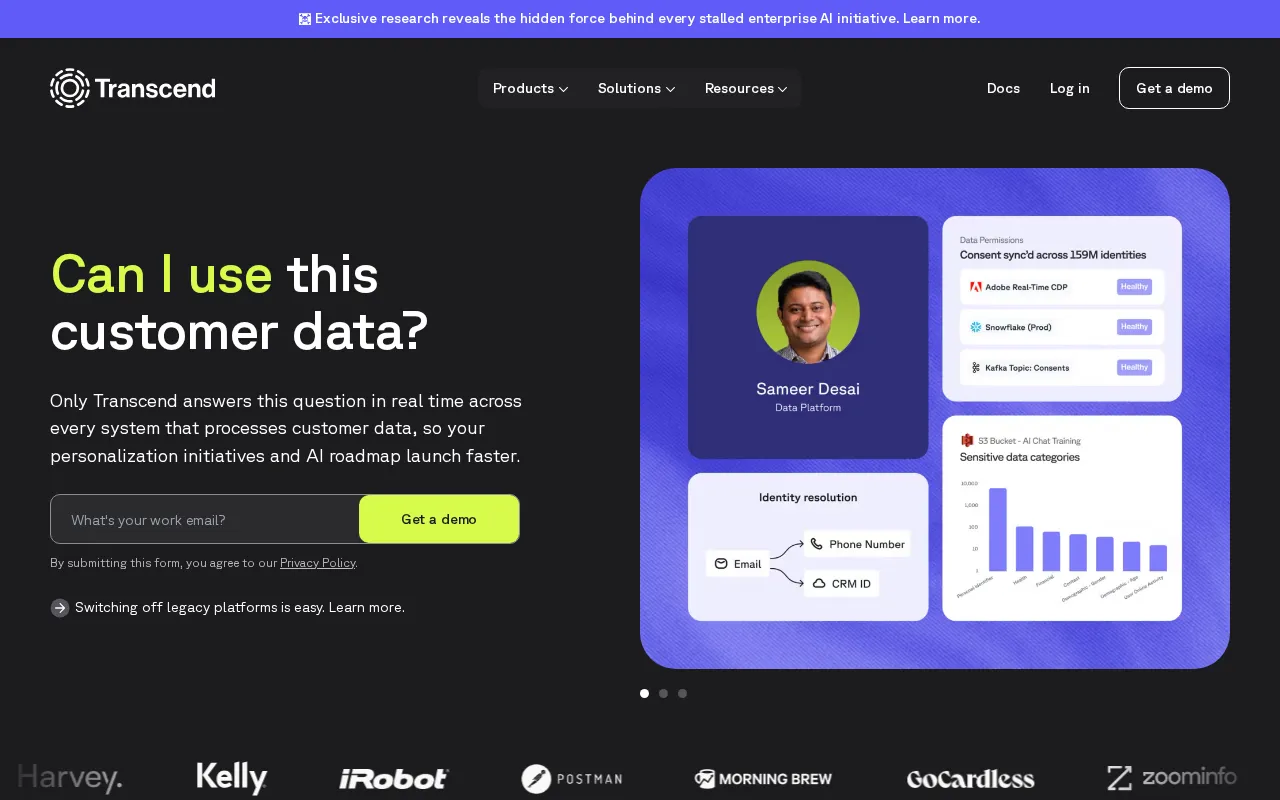
It is the compliance layer for customer data, covering GDPR, CPRA, US state privacy laws and emerging AI laws. It embeds data-use permissions directly into the systems that process customer data, answering the question of whether you can use this data in real time.
Transcend fits when your problem is customer-data consent and rights, not a security-framework checklist. It covers GDPR, CPRA, US state laws and emerging AI laws by embedding data-use permissions at the source, so confirm those are the regimes you need. Treat SOC 2 or NIST framework coverage as out of scope, and pair Transcend with a GRC tool for those. Connect the systems where personal data lives from the 1,300-plus integrations. Use the unified preference store so one consent applies everywhere, and rely on the Sombra gateway to keep data in your environment. Plan for the human remainder: AI and personalization business decisions, and engineering for homegrown systems. Confirm privacy obligations against ISO 27701 and the regulations themselves.
- Transcend is regulation-first, covering GDPR, CPRA, US state and AI laws through consent and data rights.
- Permissions are embedded at the source and enforced in real time across systems.
- Security frameworks like SOC 2 and NIST are out of scope, and AI and personalization stay human decisions.
- Regulations
- GDPR, CPRA, US state, AI laws
- Approach
- Permissions embedded at source
- Real time
- Can I use this data, answered live
- Integrations
- 1,300+ pre-built
- Measured vs
- ISO 27701 (privacy PIMS)
This page covers which privacy regulations Transcend supports and how permissions map. Its automation mechanics and pricing live on their own pages.
Plan your framework stack in Transcend
Select the frameworks you need. Transcend cross-maps the controls every framework shares, so you satisfy them once, then see exactly what each framework adds on top.
Pick at least two frameworks to see what Transcend lets you reuse, and what each one adds on top.
Transcend captures consent and data-use permissions once and enforces them everywhere, so the shared core is satisfied once across the privacy regimes you pick. Regulation-specific items layer on top; security frameworks are out of scope.
What Transcend covers and how deep
- Transcend is the only platform that embeds data-use permissions directly into customer data systems.
- It answers Can I use this customer data in real time across every system that processes it.
- It stays on the forefront of emerging compliance such as AI and US laws to meet requirements globally.
- Sensitive data can be used for AI with consent automatically enforced at the source.
- Privacy coverage is measured against an external standard: ISO/IEC 27701 sets the requirements for a Privacy Information Management System for PII controllers and processors and helps demonstrate compliance with GDPR.
- Its security base is ISO/IEC 27001, the standard that defines the requirements an information security management system must meet, which a privacy program extends.
Compliance frameworks Transcend automates
| Regulation | Category | What it proves |
|---|---|---|
| GDPR | Privacy | EU consent and data rights |
| CPRA | Privacy | California privacy rights |
| US state privacy laws | Privacy | Emerging US consumer laws |
| AI laws (EU AI Act) | AI | Consent for AI use of data |
| Healthcare / Fintech | Vertical | Industry data-rights solutions |
| Consent / preferences | Operation | Consent and preference management |
| DSRs / data rights | Operation | Data subject request fulfillment |
| Global coverage | Scope | Meet compliance requirements globally |
Transcend control mapping and coverage
| Capability | How it works | Detail |
|---|---|---|
| Permissions at source | Embedded in systems | Enforced where data is used |
| Unified preference store | Synced everywhere | Across all channels, brands, systems |
| Policy-driven decisions | Embedded in stack | Eliminates brittle consent scripts |
| Multipurpose integrations | Per connection | Identity mapping, DSRs, discovery, preferences |
| Consent enforced at source | Real time | Use sensitive data for AI with consent |
| Customer-side control | Sombra gateway | Runs in your environment, your keys |
Evidence Transcend collects automatically
- Audit-ready compliance is the default, letting privacy and legal teams stay ready for regulatory review.
- Data Inventory discovers where personal data lives across silos, structured and unstructured sources.
- DSR Automation fulfills data-subject requests across all connected systems.
- Automated preference syncing removes manual datapoint labeling, missing systems and downstream gaps.
- With Sombra, data stays in your environment and Transcend never sees it, so the evidence is consent and data-flow signals.
Integrations that feed evidence into Transcend
| Integration | Type | Capabilities | Setup |
|---|---|---|---|
| Cloud | Infrastructure | AWS, Azure, GCP · Amazon S3 | Connect |
| Data warehouses | Data | Snowflake, BigQuery · Personal data discovery | Connect |
| CRM | SaaS | Salesforce · Identity mapping, DSRs | Connect |
| Marketing / ads | Marketing | Marketo, Facebook Ads, Google Ads · Google Analytics | Connect |
| Productivity | SaaS | Microsoft Office 365 · Personal data | Connect |
| Collaboration / SaaS | SaaS | Slack, SurveyMonkey, Gainsight · Attentive | Connect |
| Custom functions | Custom | Engineering-written code · Homegrown systems | Build |
| Multipurpose support | Operation | Identity mapping, DSRs · Discovery, preferences | Connect |
Transcend coverage gaps to verify
- Transcend is consent, preference and DSR focused, so security frameworks like SOC 2 and NIST are not its scope.
- AI, retail media and personalization initiatives still require human business decisions, even with consent automated.
- Custom functions for homegrown systems require engineering-team involvement to write the code.
- Because Transcend never sees your data under the Sombra model, its evidence is consent and data-flow signals, not a full data copy.
- Coverage is readiness, not the certificate: ISO/IEC 27701 sets out the privacy management requirements, but certification comes from an accredited body after an external audit.
Transcend Framework Coverage FAQ
Which regulations does Transcend cover?
Transcend is regulation-first, covering GDPR, CPRA, US state privacy laws and emerging AI laws by managing consent and data rights. It stays on the forefront of emerging US and AI compliance to meet requirements globally. Security frameworks like SOC 2 and NIST are out of scope. Transcend is the consent and data-rights layer, not a full GRC platform.
How does Transcend reuse compliance work?
By embedding data-use permissions directly into customer data systems and keeping a unified preference store synced across all channels, brands and systems. A consent or preference captured once is enforced everywhere customer data flows, and policy-driven decisions are embedded directly into your stack, eliminating brittle consent scripts.
How is coverage kept current rather than point-in-time?
Through real-time enforcement and continuous discovery. Transcend answers whether you can use a given piece of customer data in real time across every system that processes it. It enforces consent at the source and runs Data Inventory across silo, structured and unstructured sources. Coverage reflects where personal data actually lives, not a snapshot.
Does Transcend cover security frameworks like SOC 2?
No. Transcend is a privacy and consent layer for customer data, focused on GDPR, CPRA and similar regulations, and on consent, preferences and DSRs. Security and audit frameworks like SOC 2 and NIST are out of scope, so pair Transcend with a GRC platform if you need framework attestations.
What is the Sombra model and how does it affect coverage?
Sombra is Transcend's proprietary security gateway that runs entirely in your environment, so you keep your API keys and Transcend never sees your data. That strengthens data control, but it means Transcend's evidence is consent and data-flow signals rather than a copy of your data, which is by design for a privacy layer.
Sources & verification
| Source | What was checked | Last checked |
|---|---|---|
| Transcend Official | Official product page | July 10, 2026 |
| ISO/IEC 27701 | ISO/IEC 27701 requirements | July 10, 2026 |
| Transcend Integrations | Integrations and connectors | July 10, 2026 |
Every fact on this Transcend page is tied to a named source and a verification date. Freshness-sensitive figures trace to the sources above; verify against the vendor before relying on them.
Explore Transcend
Every page on Transcend in one place, you are on framework coverage.
Snapshot, score and verdict
How it collects and automates compliance evidence
You are here
Every tier and the entry price
Compared and ranked vs peers
Price and feature change history
Browse the full Compliance Automation category