
pgvector Pricing: Plans & Cost Guide 2026
Open Source is free, offering a complete vector database as a PostgreSQL extension compared to paid alternatives.
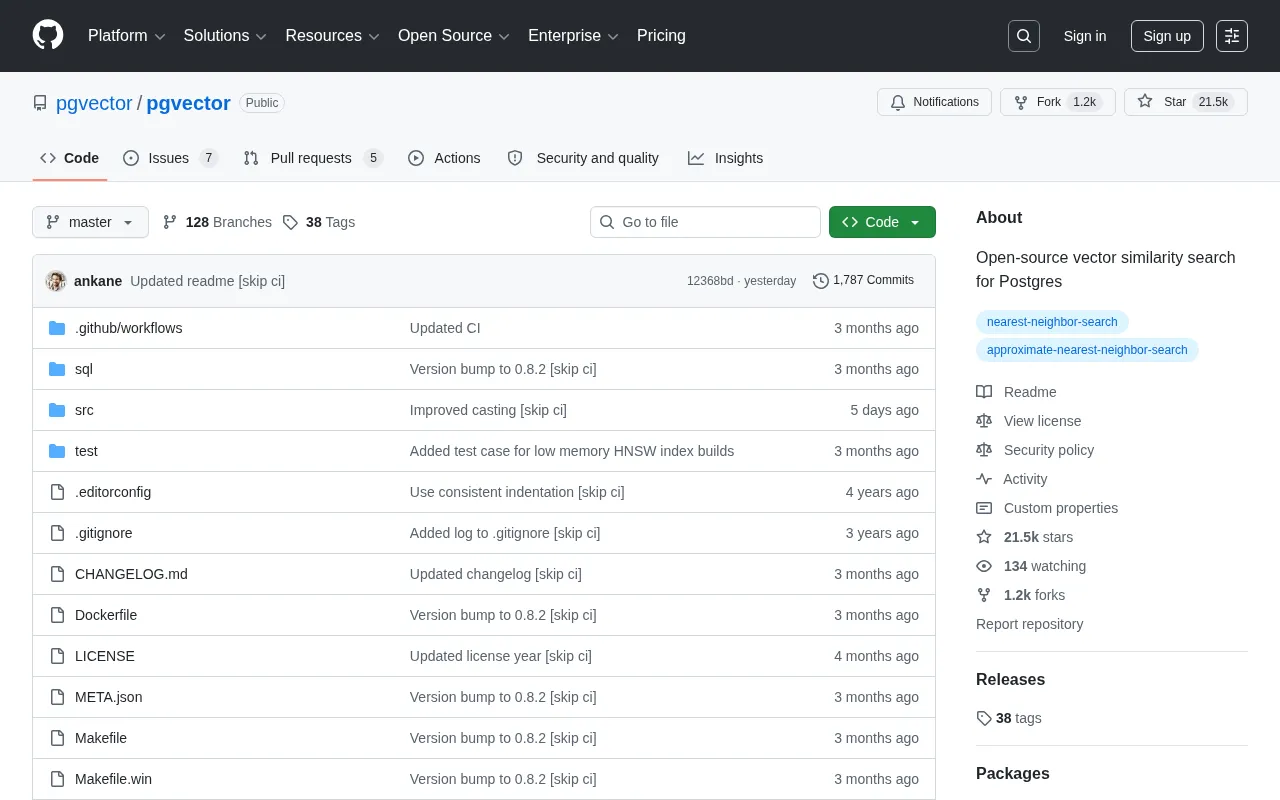
pgvector plans and pricing
Open Source
You get a fully-featured, self-hosted PostgreSQL extension for vector search
pgvector pricing: the quick answer
pgvector is free as of July 8, 2026. It is an open-source PostgreSQL extension under the MIT license, so there is no subscription, per-seat fee or usage meter for the software. You get exact and approximate nearest-neighbor search with HNSW and IVFFlat indexing across the usual distance metrics, up to 16,000 dimensions, all inside your existing Postgres tables with ACID guarantees. What you pay for is the database that runs it: your own server, or a managed host like Supabase, Neon or Railway. On Postgres already, the extension itself is free.
- Open SourceFree
pgvector is free to start, against a $82/mo median across 8 vector databases tools we track.
pgvector pricing, read against its live plans and category
Positioning
pgvector is a free, open-source PostgreSQL extension under the MIT license, so the software carries no licensing fee at any scale. It handles vector similarity search across L2, cosine, inner-product and L1 distance, exact and approximate nearest-neighbor with HNSW and IVFFlat indexing, and up to 16,000 dimensions on HNSW, all inside your existing Postgres. For teams already running Postgres, it removes the need to stand up and pay for a separate vector database, which is the whole reason it has spread so fast.
Cost drivers
- 1The extension is free, but the database it runs in is not: large vector indexes need real RAM, and provisioning that on a cloud instance or managed Postgres host drives the actual cost.
- 2Scaling performance means hands-on index tuning, so the real spend is engineering time or a managed provider's higher tier rather than any pgvector fee.
- 3Managed Postgres hosts such as Supabase, Neon and Railway each bill separately for the underlying database.
Watch-outs
The risk is not billing but a performance wall: at tens of millions of vectors you can hit slow index builds and query latency that only faster hardware or add-on extensions fix.
Strengths
- No new infrastructure: it runs inside the Postgres you already operate.
- A SQL interface every backend developer already knows.
- ACID transactions across vectors and relational data in one place.
Editor’s take
For any team already on PostgreSQL, pgvector is the obvious starting point and comfortably handles a few million vectors for the price of the hosting alone. If your dataset climbs into the tens of millions and RAM provisioning on the database gets expensive, that is the moment to weigh a dedicated managed vector store like Pinecone for query latency at scale.
 Oleh KemFounder & Lead Analyst
pgvector Hidden Costs & Pitfalls
List price covers the subscription. Total cost of ownership for pgvector typically includes additional line items that don't appear on the pricing page.
pgvector price history
Cheaper Vector Databases tools



Frequently asked questions
Sources & verification
| Source | What was checked | Last checked |
|---|---|---|
| Official Website | Official vendor website | — |
| G2 | G2 verified user reviews · 3.8/5 · 12 reviews | — |
Every fact on this pgvector pricing page is tied to a named source and a verification date. Freshness-sensitive figures trace to the sources above; verify against the vendor before relying on them.
Explore pgvector
Every page on pgvector in one place, you are on pricing.
Snapshot, score and verdict
Framework/SDK integrations for retrieval workloads
Latency, throughput, uptime and behaviour under scale
You are here
Compared and ranked vs peers
Price and feature change history
Browse the full Vector Databases category