
Best Keystone Alternatives in 2026
Looking for a cheaper option than Keystone's $49 hardware? Switch to SafePal (free to $89.99) if you want a lower entry price for secure offline storage.
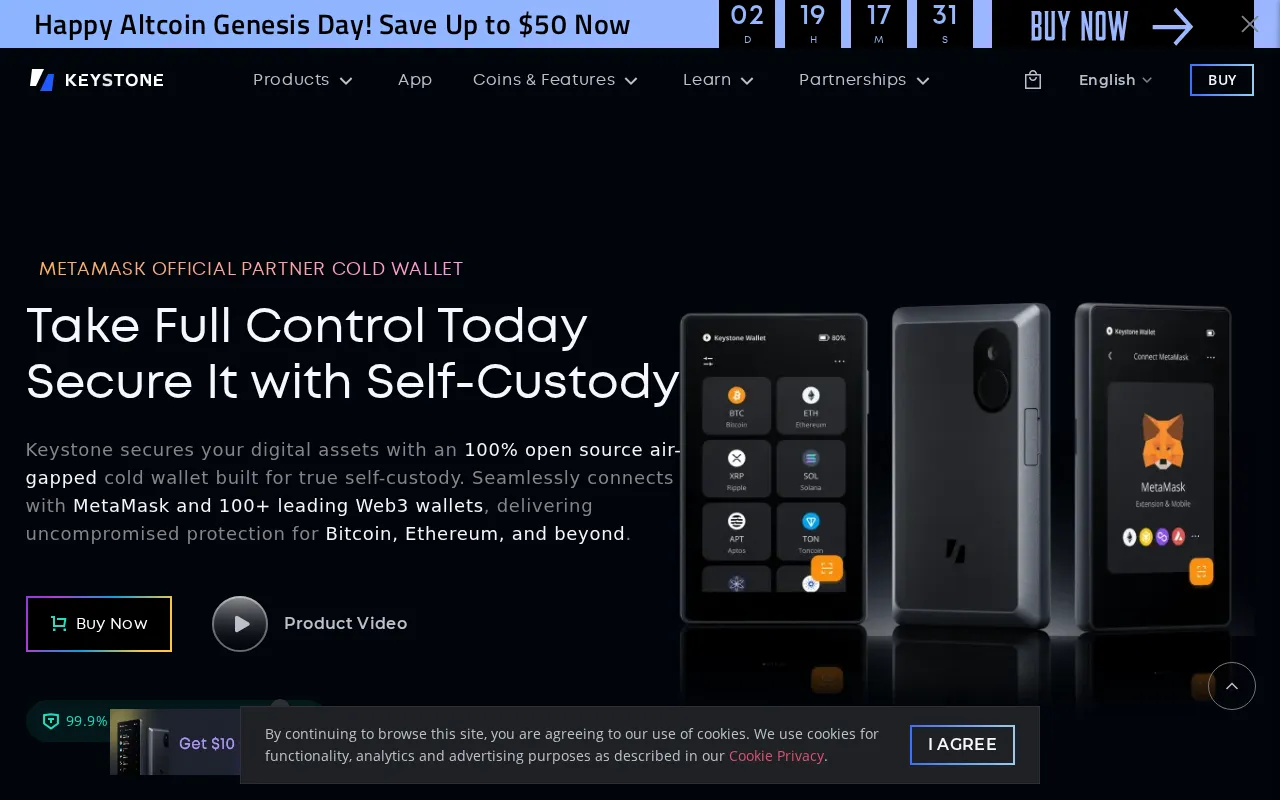
Feature Overview: Top Keystone Alternatives
Keystone compared against all 10 crypto wallets alternatives. Pricing, free plan availability, rating, and crypto wallets-specific capabilities.


How Does Keystone Compare to Alternatives?
Independently verified metrics. Sources: Vendor documentation, independent research. Verified 2026.
| Tool | Chains | Open Source | Hardware Support |
|---|---|---|---|
| Keystone (this) | 30 | Yes | Yes |
| Phantom | 4 | No | No |
| SafePal | 100 | No | Yes |
| MetaMask | 30 | Yes | No |
| Trezor | 20 | Yes | Yes |
| Rabby Wallet | 100 | Yes | No |
| Ledger | 50 | No | Yes |
| Exodus | 50 | No | Yes |
When Should You Stick with Keystone?
Alternatives are not always the right move. Keystone remains strong in these scenarios.
- +True air-gap via QR codes is the most secure hardware wallet connectivity model
- +Largest display (4-inch) enables clear transaction and smart contract review
- +Fully open-source firmware is independently verifiable by security researchers
- +Extensive software wallet compatibility (MetaMask, Rabby, Phantom, BlueWallet)
- +Dual secure element in Keystone 3 Pro adds chip-level redundancy
- -QR code signing workflow adds more steps than USB-connected wallets
- -Less mainstream recognition than Ledger or Trezor outside advanced users
- -Shenzhen manufacturing location creates some jurisdictional trust concerns
- -No companion mobile app - requires third-party wallet for full functionality
Keystone Alternatives by Asset & Security
10 alternatives evaluated by features, pricing, and real-world use cases.
Expert Take
Multisig users already running MetaMask or Rabby give up nothing by choosing a QR-only signer that ships without a wallet app. Keystone is also the only record here selling a stainless-steel seed backup as a product in its own right.
 Oleh KemFounder & Lead Analyst
Multi-chain crypto wallet for Solana, Ethereum, Bitcoin, and Polygon with built-in swaps and NFT gallery.. Rated 4.8/5 vs 4.4/5 for Keystone.
- +Best-in-class Solana wallet with polished UX and NFT display
- +Multi-chain support: Solana, Ethereum, and Bitcoin
- +In-app staking for SOL and Solana ecosystem tokens
- +Strong browser extension and mobile app maintained consistently
- −Ethereum features less complete than MetaMask or Rabby
- −Bitcoin support basic vs. dedicated BTC wallets
- −Closed-source wallet code limits independent security auditing

Affordable hardware and software wallet with 10M+ users, 10,000+ supported tokens, and deep Binance ecosystem integratio. Rated 4.6/5 vs 4.4/5 for Keystone.
- +Most affordable hardware wallet with true air-gap QR signing
- +Widest token support: 10,000+ assets across 100+ networks
- +Free software wallet app pairs well with hardware for flexible security
- −Binance Labs backing raises independence questions for a security product
- −Build quality and display size trail Ledger and Trezor at similar price points
- −Air-gap QR process adds steps versus USB-connected hardware wallets

Most popular Ethereum and EVM wallet with browser extension, mobile app, and built-in swap aggregator..
- +Industry-standard for EVM chain compatibility - every dApp supports it
- +30M+ users means best community resources and support documentation
- +Hardware wallet integration with Ledger and Trezor
- +Browser extension plus mobile apps for iOS and Android
- +Ethereum Wallet Management
- +Browser Extension Support
- +Mobile App Availability
- +Swap Aggregator Integration
- −Default Infura RPC creates privacy concerns - IP/transaction logging
- −Built-in swap rates often inferior to direct DEX or 1inch
- −EVM-only - no native Bitcoin or Solana support

Open-source hardware wallet pioneer with Trezor Suite software and full air-gapped security option.. Rated 4.7/5 vs 4.4/5 for Keystone.
- +Fully open-source firmware - independently audited by security researchers
- +Industry's longest hardware wallet track record since 2014
- +Trezor Safe 3 adds secure element while maintaining open source
- −Older models lack secure element (addressed in Safe 3)
- −Fewer native coin support entries than Ledger for some assets
- −Companion app less feature-rich than Ledger Live for staking/DeFi

DeFi-focused browser wallet by DeBank with pre-transaction risk scanning and multi-chain support.. Has a free tier that Keystone lacks.
- +Pre-transaction simulation showing exact wallet changes before signing
- +Automatic chain switching without manual network configuration
- +Open-source code with regular security updates
- +Built by DeBank team - deep DeFi protocol context and labeling
- +Multi-Chain Support
- +Pre-Transaction Risk Scan
- +DeFi Asset Management
- −Browser extension only - no mobile wallet currently
- −EVM chains only - no Solana or Bitcoin
- −Less mainstream than MetaMask - occasional dApp compatibility gaps

Industry-leading hardware wallet with Ledger Live software for secure crypto storage and DeFi access..
- +Secure element chip provides hardware-level key isolation
- +5,500+ supported assets - widest of any hardware wallet
- +Ledger Live app for portfolio management and staking
- +Direct DeFi and dApp access through Ledger Live integrations
- +Secure Crypto Storage
- +DeFi Access Enabled
- −2020 marketing database breach exposed 270k customer addresses/emails
- −Ledger Recover feature controversy raised firmware trust questions
- −More expensive than basic Trezor Model One ($79-$149 range)

Beautiful multi-platform crypto wallet with built-in exchange, staking, and Trezor hardware wallet integration.. Has a free tier that Keystone lacks.
- +Exceptional UI/UX - best visual design of any non-hardware wallet
- +Consistent experience across desktop, browser extension, and mobile
- +Built-in swap and Trezor hardware wallet integration
- +300+ assets with integrated portfolio tracking and charts
- +Multi-Platform Support
- −Closed-source code - no independent firmware audit possible
- −Built-in swap rates not competitive with DEX aggregators
- −Limited DeFi interaction capabilities

NFC card-based hardware wallet with no seed phrase, tap-to-sign security, and a 3-card backup system for 2M+ users.. Keystone edges it on ratings (4.4 vs 4.3/5).
- +No seed phrase eliminates the primary cause of crypto wallet theft
- +Card form factor is compact, durable, and fits in a physical wallet
- +NFC tap-to-sign is intuitive and fast for daily use
- −No seed phrase means no standard recovery if all cards are lost
- −NFC requires a compatible smartphone - older phones may not work
- −Firmware is partially closed-source, limiting independent security verification
Showing 8 of 10 alternatives
Common Questions About Switching from Keystone
Sources & verification
| Source | What was checked | Last checked |
|---|---|---|
| Official Website | Official vendor website | — |
| Official Pricing Page | Source of verified tiers | July 8, 2026 |
| G2 | G2 verified user reviews · 4.3/5 · 10 reviews | — |
| Capterra | Capterra verified user reviews | — |
| TrustRadius | TrustRadius verified reviews | — |
Every fact on this Keystone pricing page is tied to a named source and a verification date. Freshness-sensitive figures trace to the sources above; verify against the vendor before relying on them.