
dYdX Pricing: Plans & Fee Calculator 2026
Active traders pay $0/mo for platform usage, completely eliminating the $25/mo average subscription fee found on other decentralized exchanges.
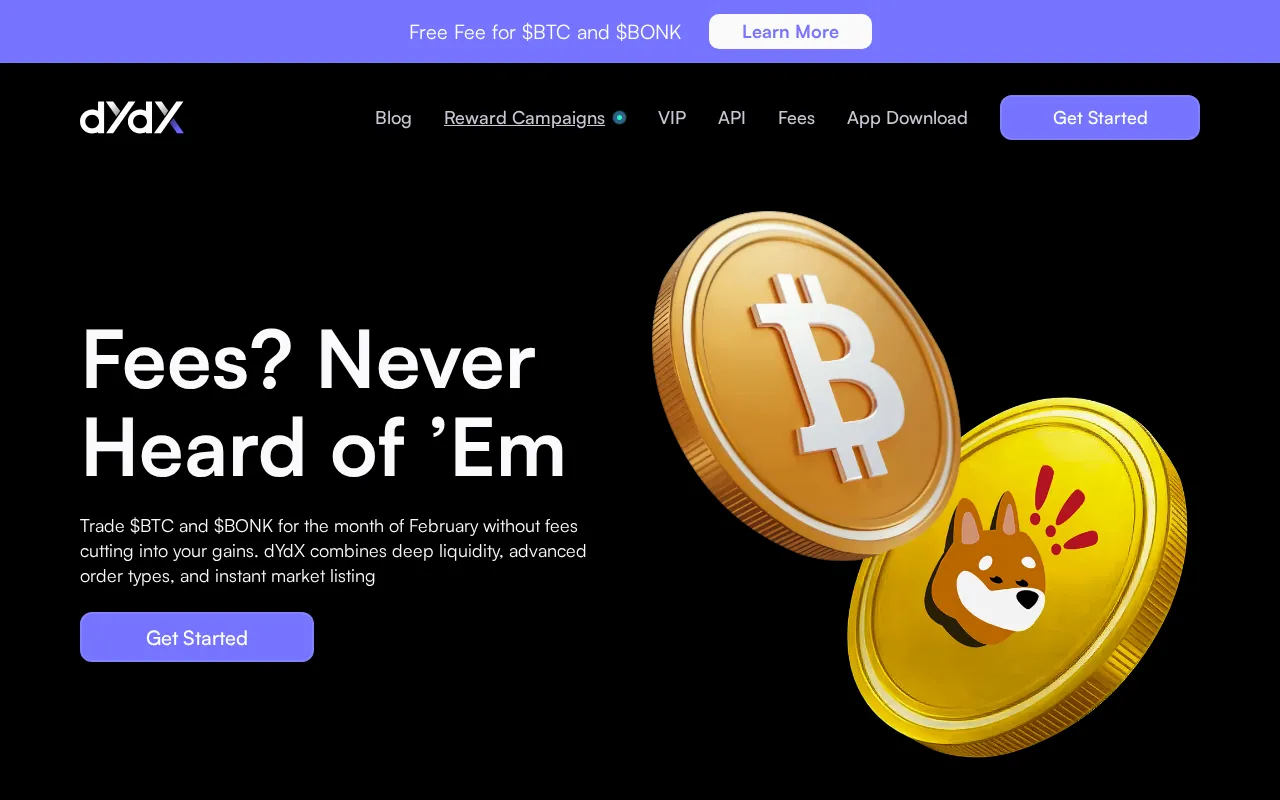
dYdX fees
| Tier | Maker | Taker |
|---|---|---|
| Default (lowest volume) | 0% | 0.10% |
| Highest volume | negative rebates | 0.05% |
Spot trading fees. Your tier is set by 30-day volume (or holdings); the calculator above estimates your cost.
dYdX pricing: the quick answer
dYdX has no subscription and no signup fee as of July 8, 2026; it is a decentralized perpetuals exchange where you pay only per trade. The captured fee table sets the taker fee at 0.10% by default, falling to 0.05% for the highest-volume traders, while the maker fee starts at 0% and turns into a rebate at high volume. Both rates step down on rolling 30-day volume, and on-chain gas is separate. For an active perpetuals trader the 0% maker floor is genuinely competitive; the model rewards volume, not idle accounts.
- Default (lowest volume)0% / 0.10%
- Highest volumenegative rebates / 0.05%
dYdX cost calculator
dYdX Hidden Costs & Pitfalls
There is nothing to subscribe to, so your cost is entirely the per-trade fee plus on-chain gas. Which side of the book you sit on and how much you trade in 30 days set the real rate.
dYdX pricing, read against its live plans and category
Positioning
dYdX is a decentralized perpetuals exchange with no subscription and no signup fee; you pay only per trade. The captured fee table sets the taker fee at 0.10% by default, dropping to 0.05% for the highest-volume traders, and the maker fee at 0% by default, becoming negative rebates at high volume. Both rates step down automatically on rolling 30-day volume. For an active derivatives trader that 0% maker floor is genuinely competitive, and the top makers actually get paid to add liquidity. The model is built to reward volume and liquidity provision, so its value depends entirely on how you trade, not on any plan you pick.
Cost drivers
- 1On-chain gas is separate on every action and paid to the network, not the protocol. It weighs hardest on small positions, where a fixed gas charge outsizes the sub-tenth-of-a-percent trading fee.
- 2The lowest fees are gated by 30-day volume. Casual traders sit at the 0.10% taker default and the 0% maker floor, not the rebate tier.
Strengths
- No subscription, no signup fee, and full self-custody of assets.
- Maker fees start at 0% and reach negative rebates, so high-volume liquidity providers are paid to trade.
- Deep order-book liquidity for perpetuals with automatic volume discounts, no negotiation required.
Editor’s take
For a serious perpetuals trader, dYdX's per-trade model is hard to fault: the maker side starts free and the taker side is already low before any volume discount. Provide liquidity with limit orders and you pay the 0% maker rate rather than the 0.10% taker rate, and enough volume turns that into a rebate. Just account for on-chain gas separately, because on small trades it is the cost that actually shows up, not the fee.
 Oleh KemFounder & Lead Analyst
dYdX price history
Cheaper Decentralized Exchanges tools


Frequently asked questions
Sources & verification
| Source | What was checked | Last checked |
|---|---|---|
| Official Pricing Page | Source of verified tiers | July 8, 2026 |
| Official Website | Official vendor website | — |
Every fact on this dYdX pricing page is tied to a named source and a verification date. Freshness-sensitive figures trace to the sources above; verify against the vendor before relying on them.
Explore dYdX
Every page on dYdX in one place, you are on pricing.